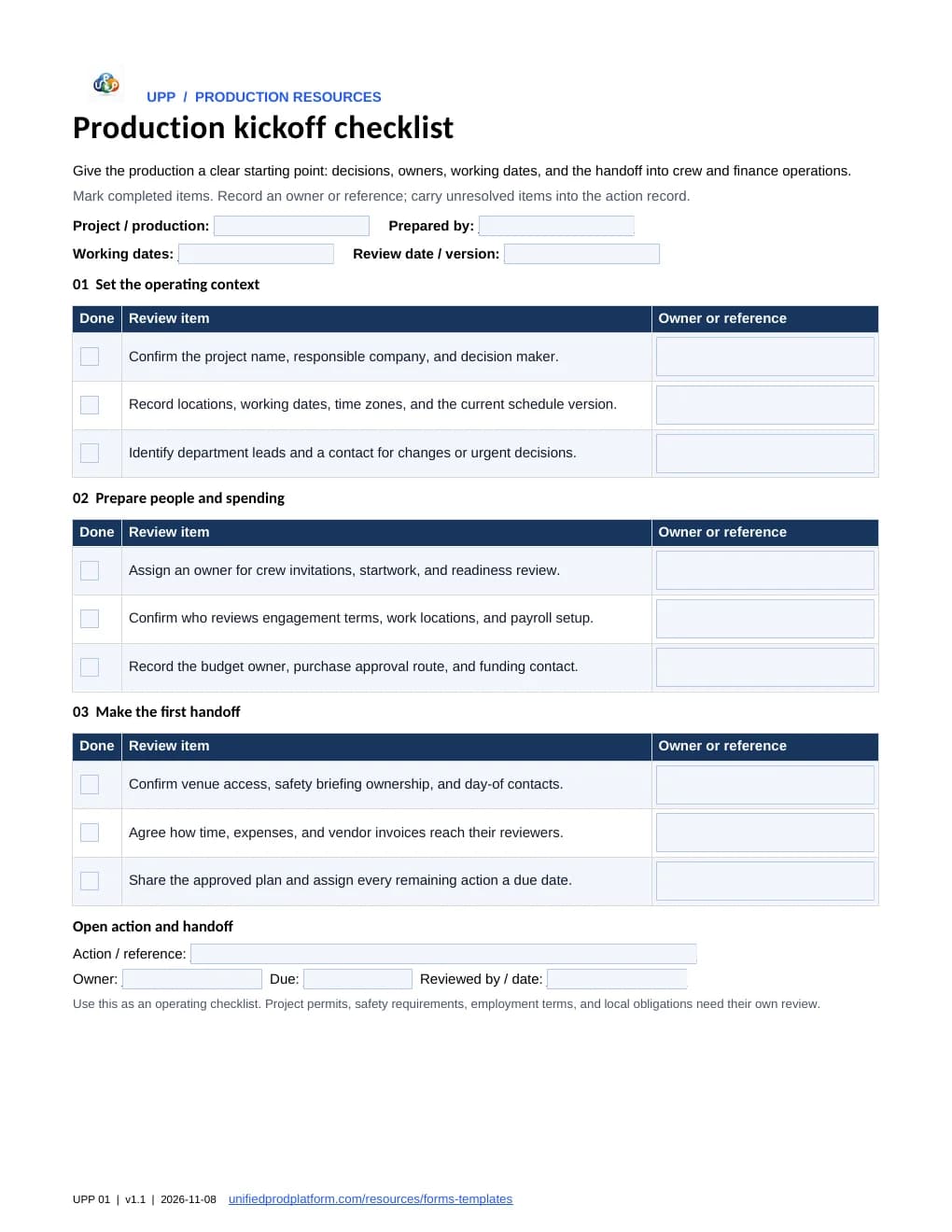
Production setupFillable PDF
Production kickoff checklist
Give the production a clear starting point: decisions, owners, working dates, and the handoff into crew and finance operations.
The UPP working collection
A clearer start, a better handoff. Original UPP forms, checklists, and worksheets for casting teams, talent, and the people who keep productions moving.
24 fillable PDFs · 7 protected Excel worksheets · Free, no sign-up
Choose a template, make it yours, and put it to work.
24 templates ready to use
Give the production a clear starting point: decisions, owners, working dates, and the handoff into crew and finance operations.
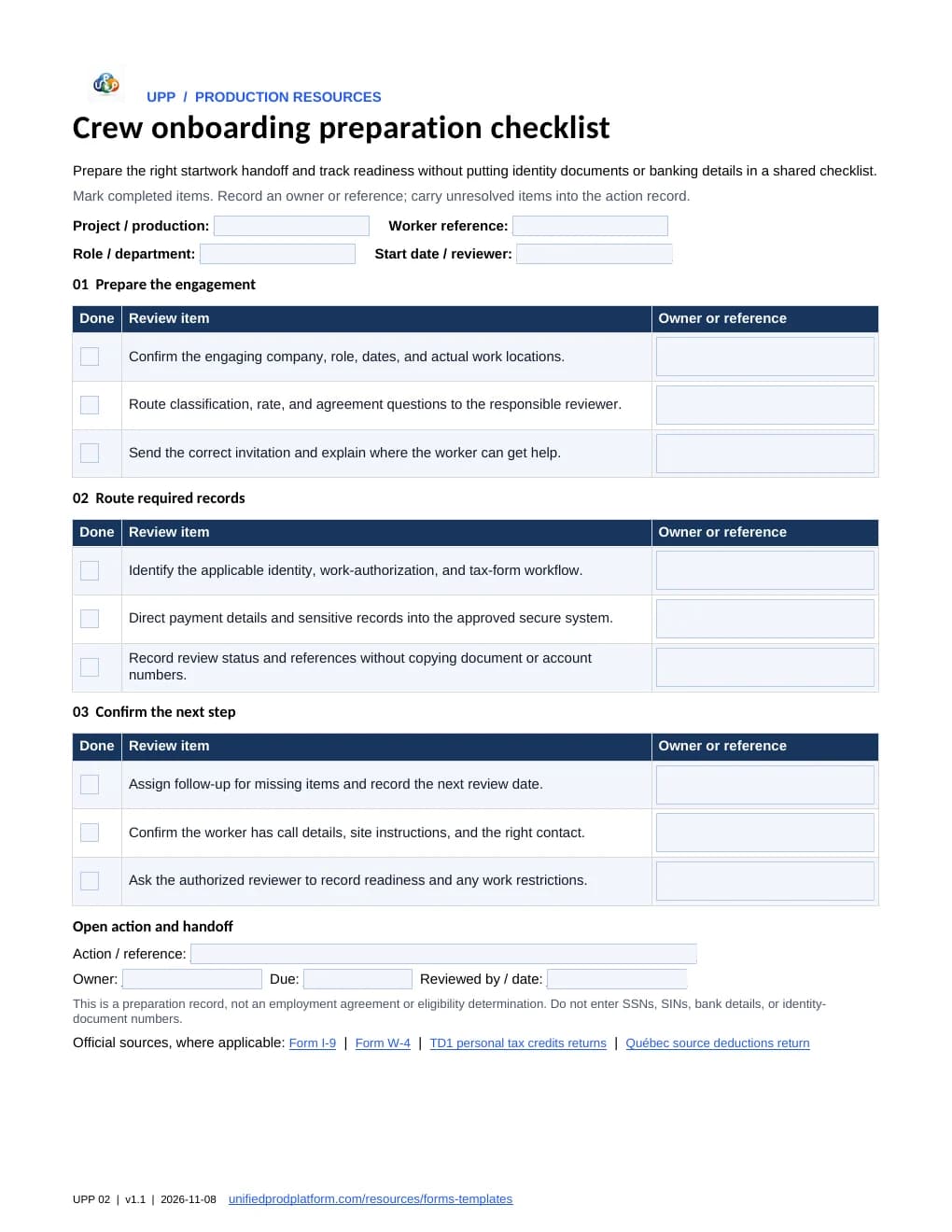
Prepare the right startwork handoff and track readiness without putting identity documents or banking details in a shared checklist.
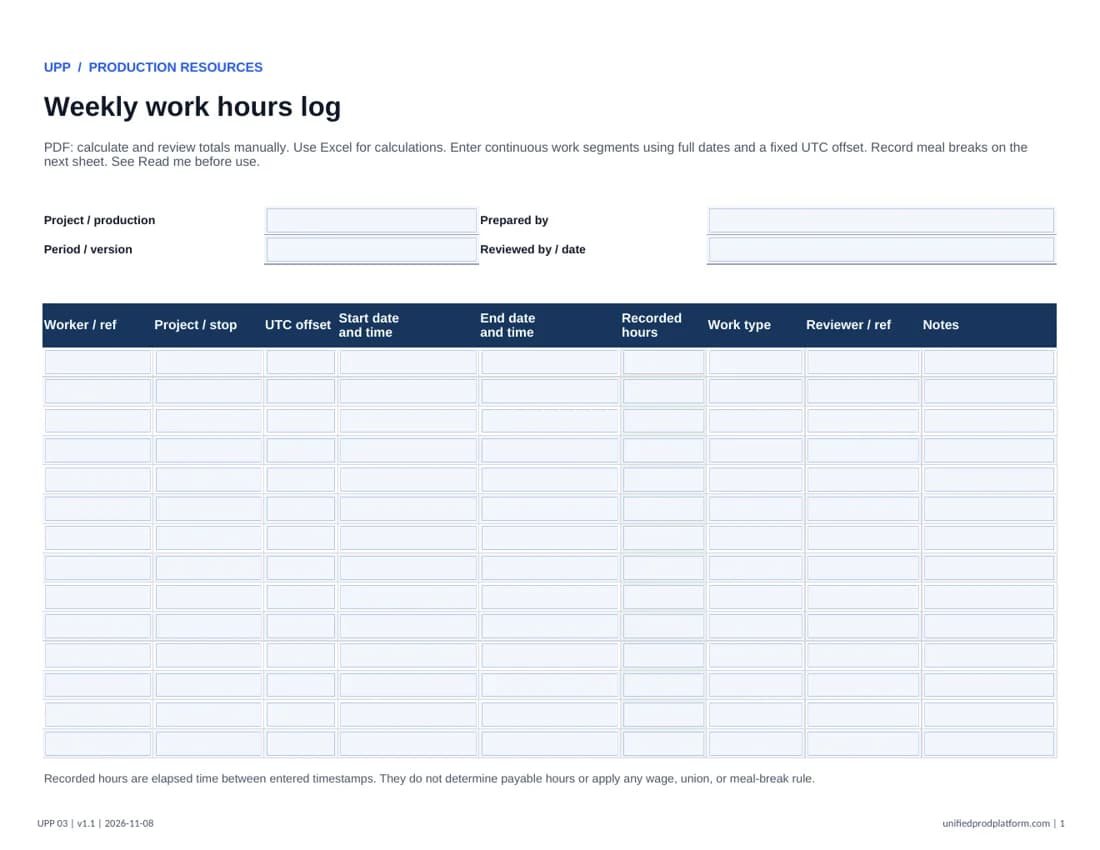
Record work segments and actual meal breaks with full dates, time-zone context, and a clear trail for payroll review.
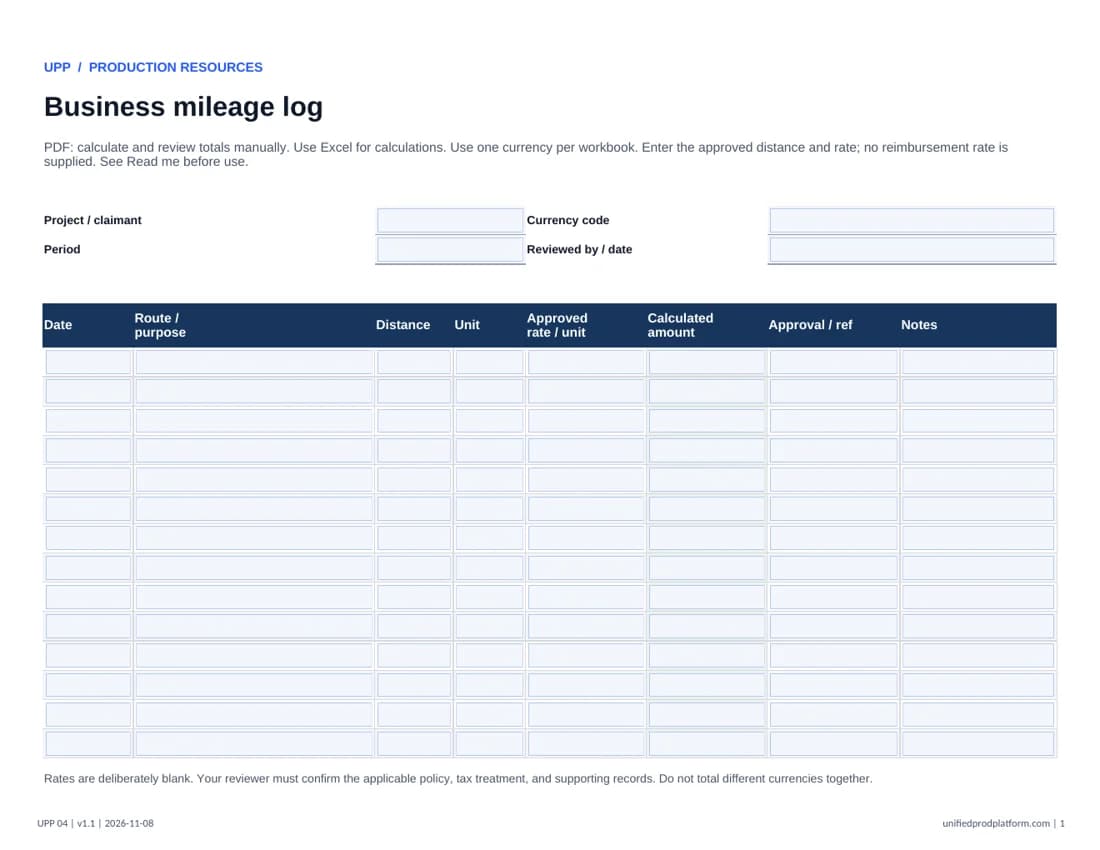
Keep business travel, receipts, approval references, and reimbursement arithmetic together without assuming a mileage rate.
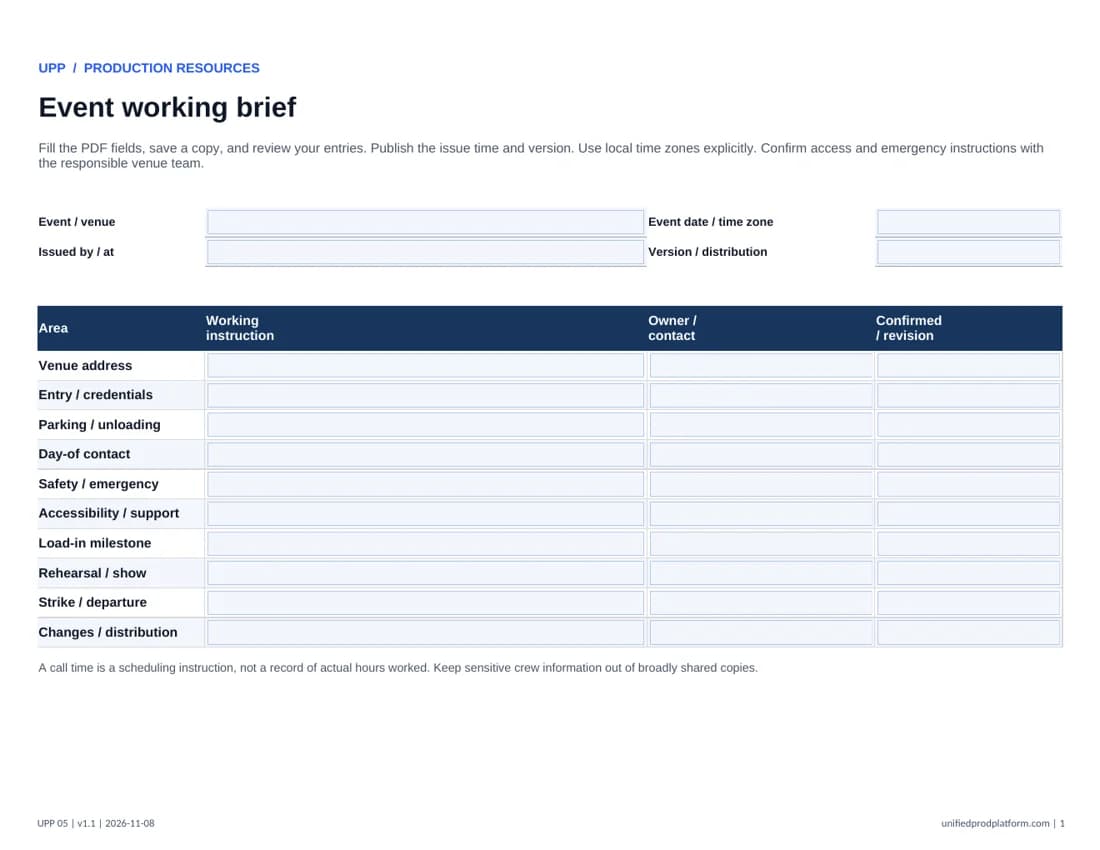
Publish one clear working brief for the venue, event milestones, department calls, and day-of changes.
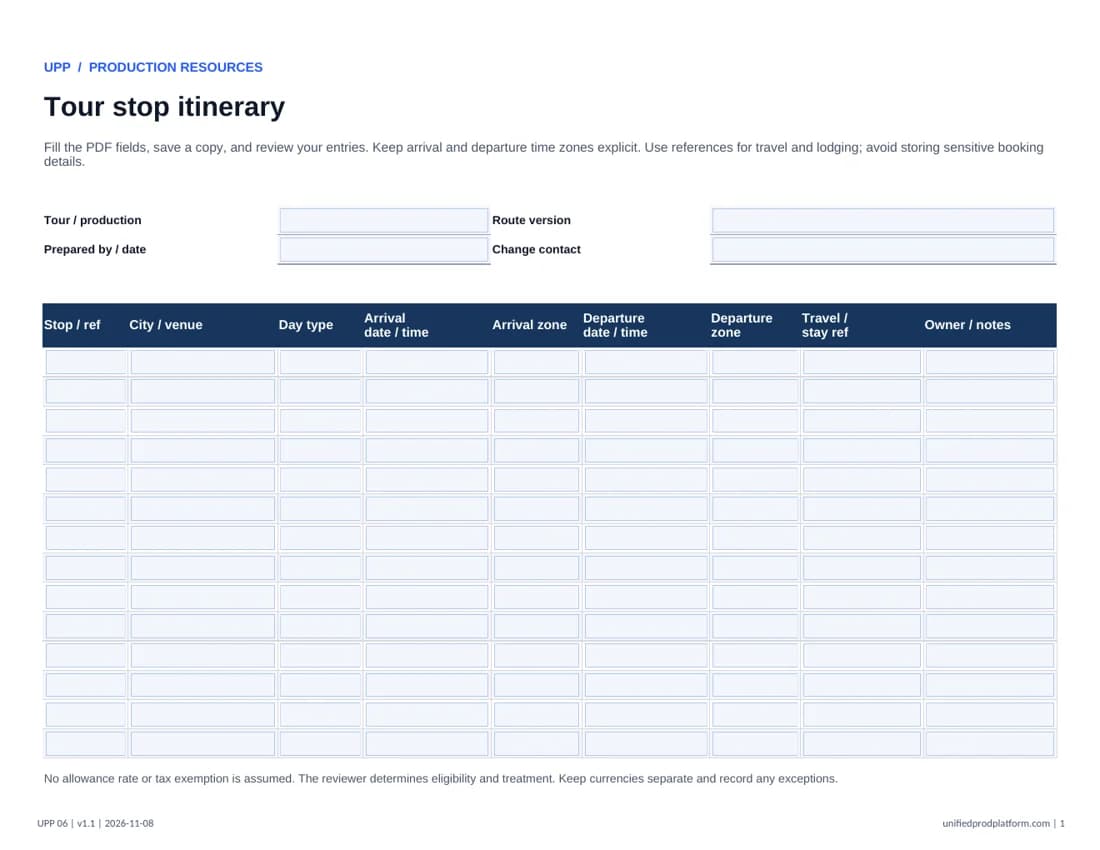
Connect each stop and travel day to its allowance record, with currencies, supplied meals, and reviewer decisions visible.
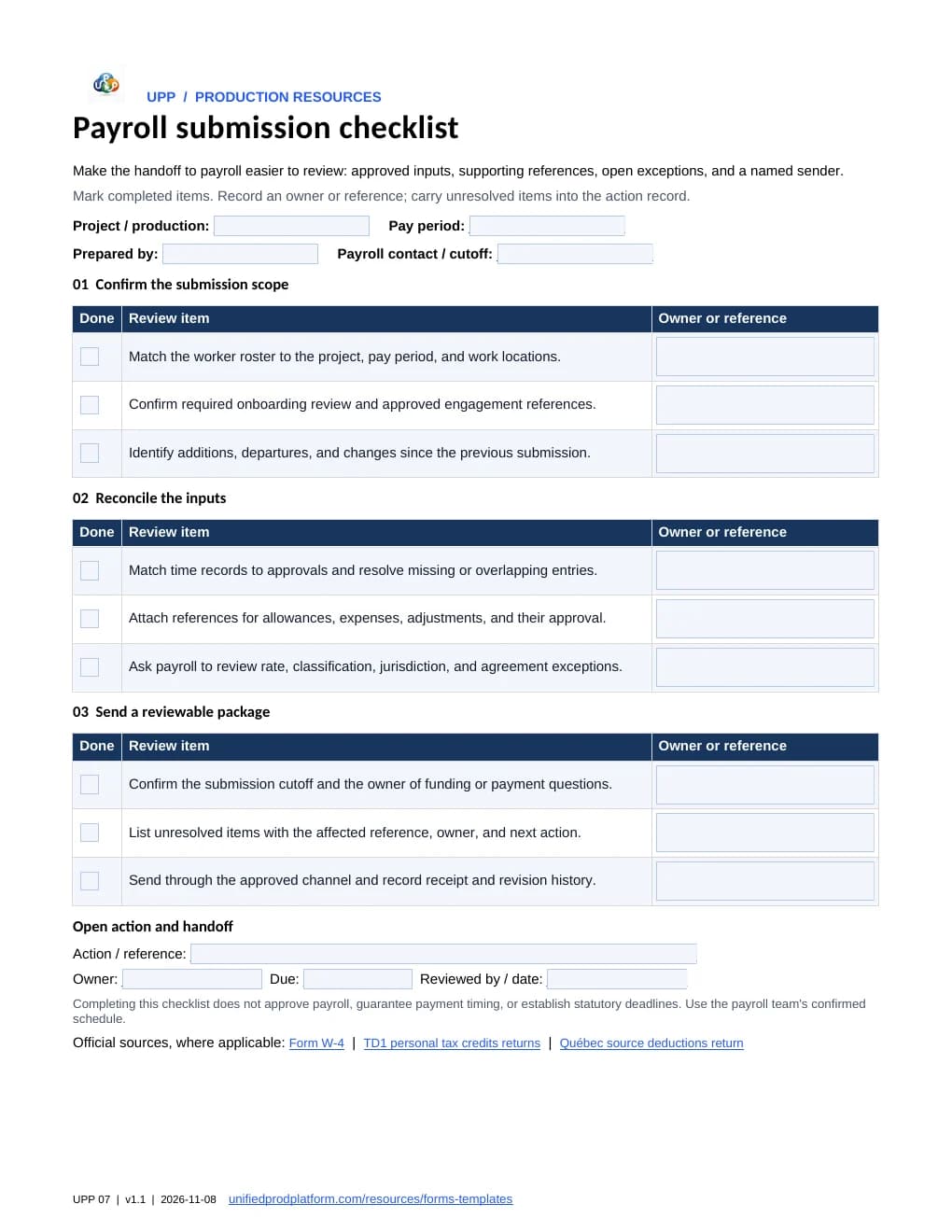
Make the handoff to payroll easier to review: approved inputs, supporting references, open exceptions, and a named sender.
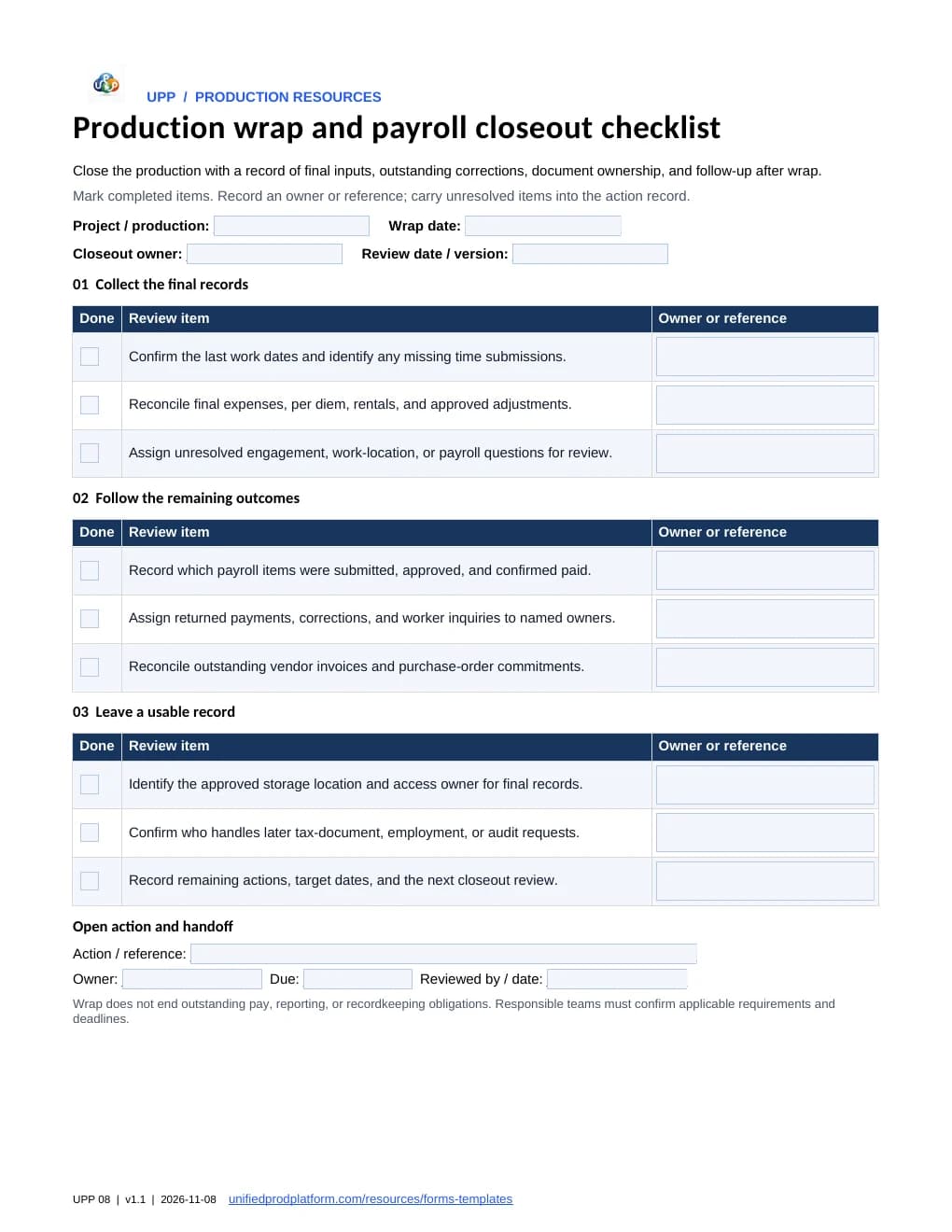
Close the production with a record of final inputs, outstanding corrections, document ownership, and follow-up after wrap.
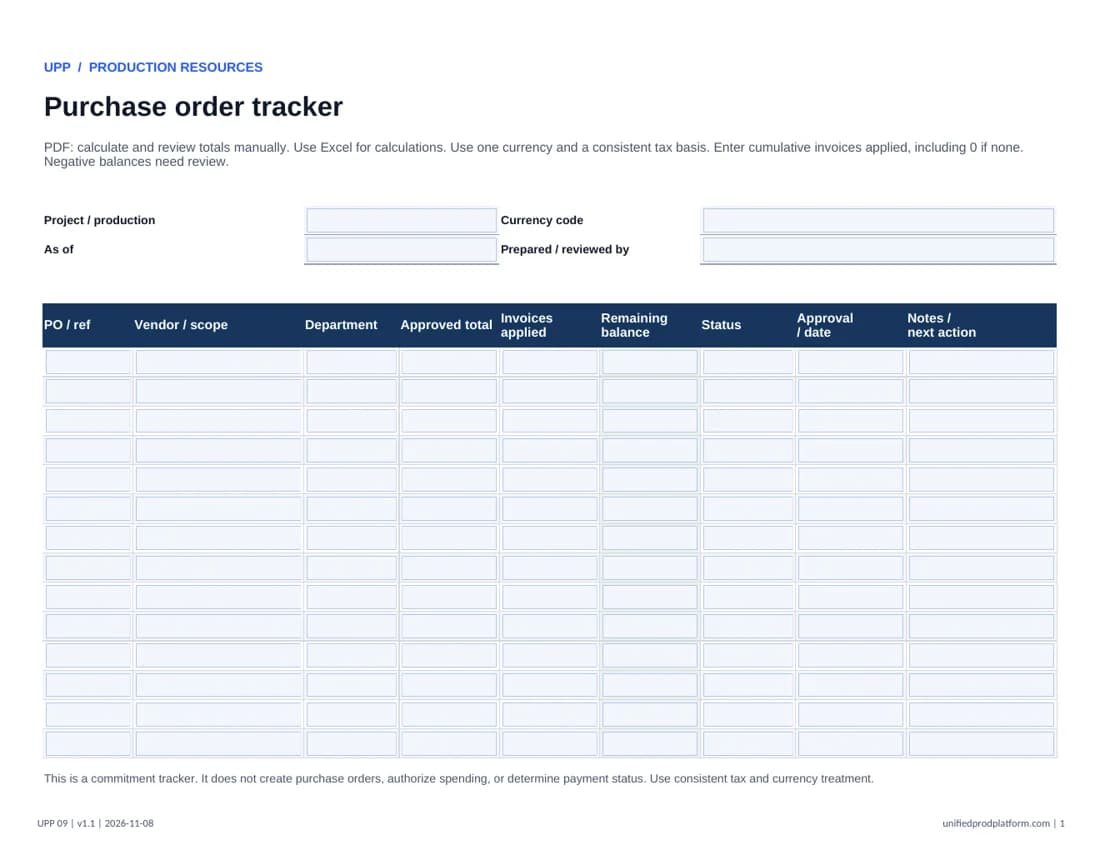
Track approved commitments, invoices applied, and the remaining balance with department and approval references in view.
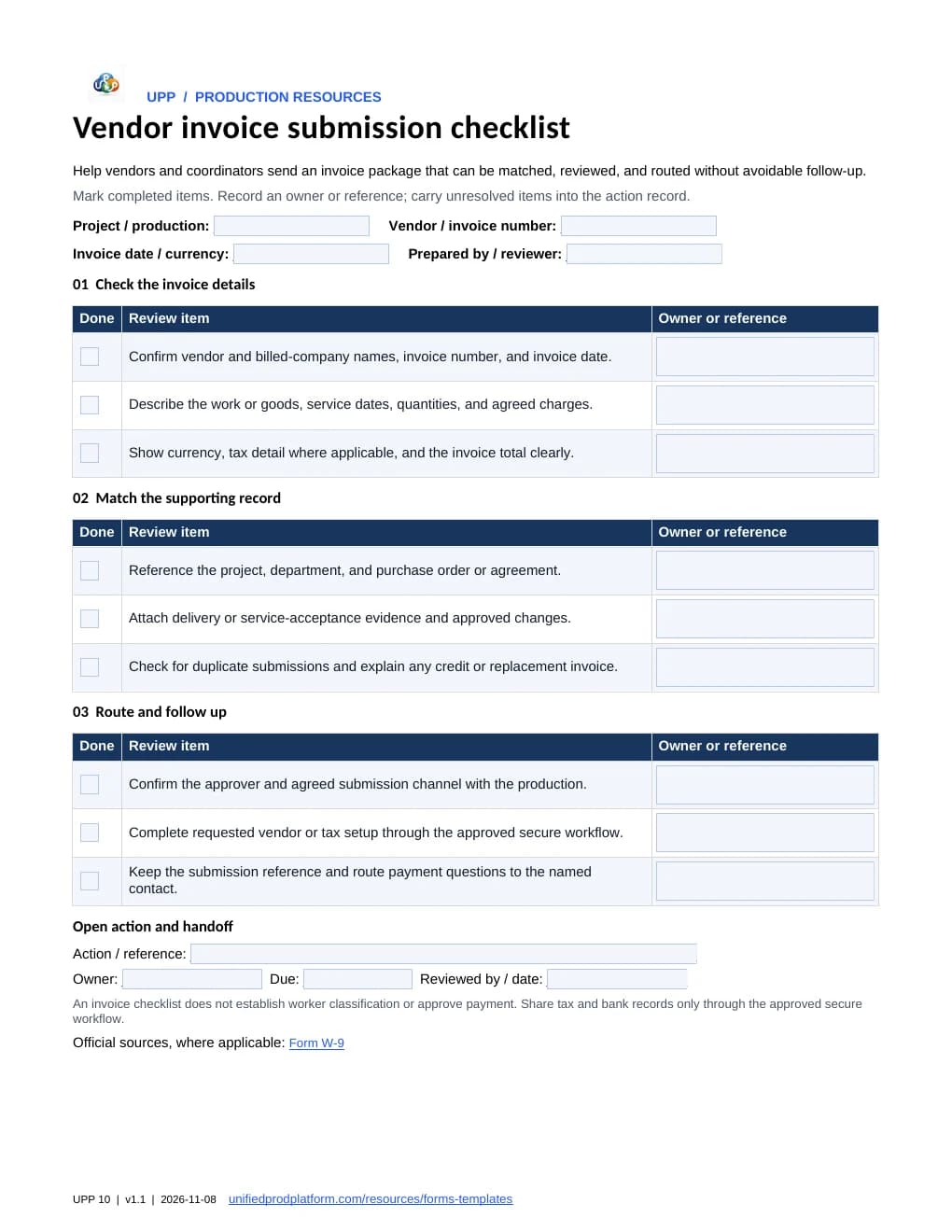
Help vendors and coordinators send an invoice package that can be matched, reviewed, and routed without avoidable follow-up.
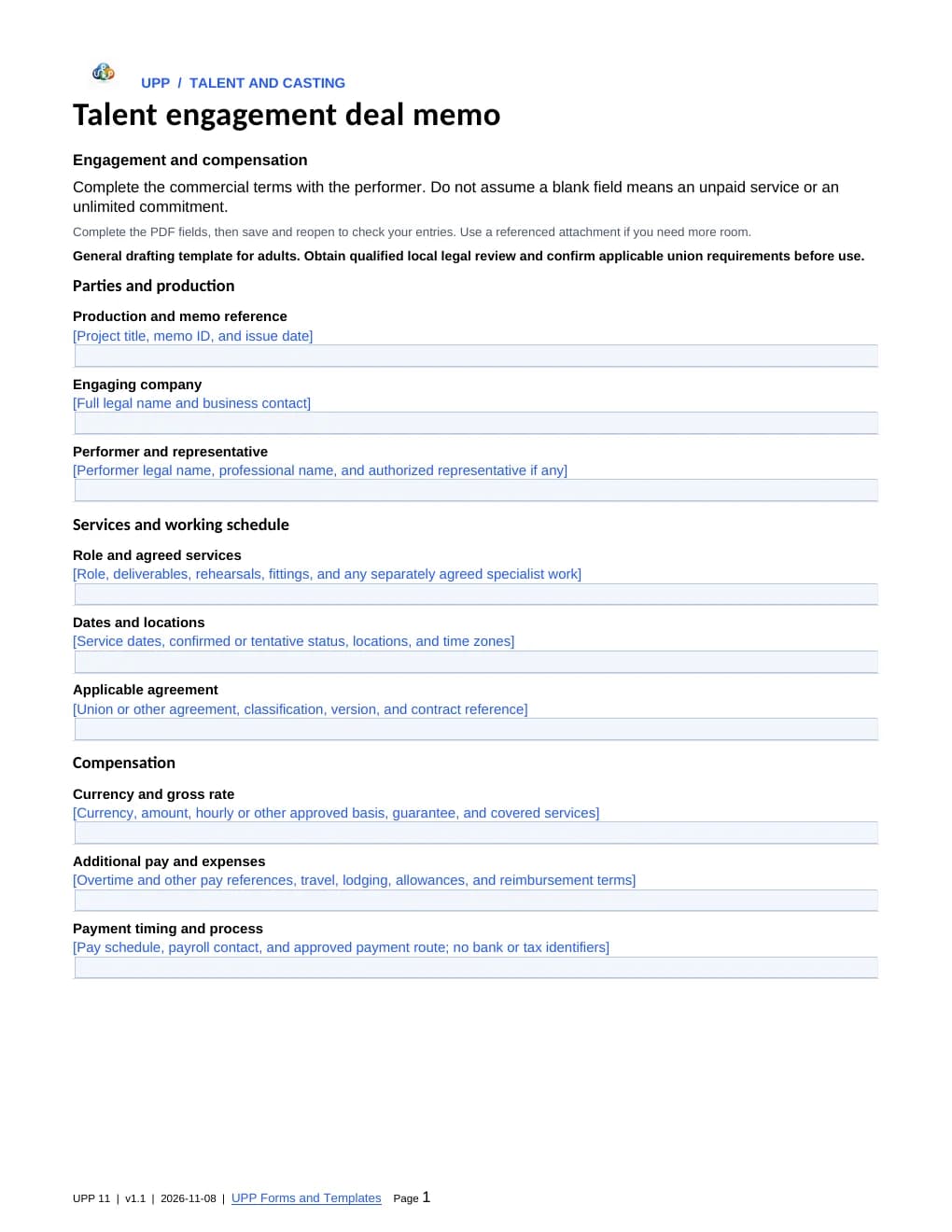
Put the role, services, compensation, dates, and agreed attachments in one readable record for an adult talent engagement.
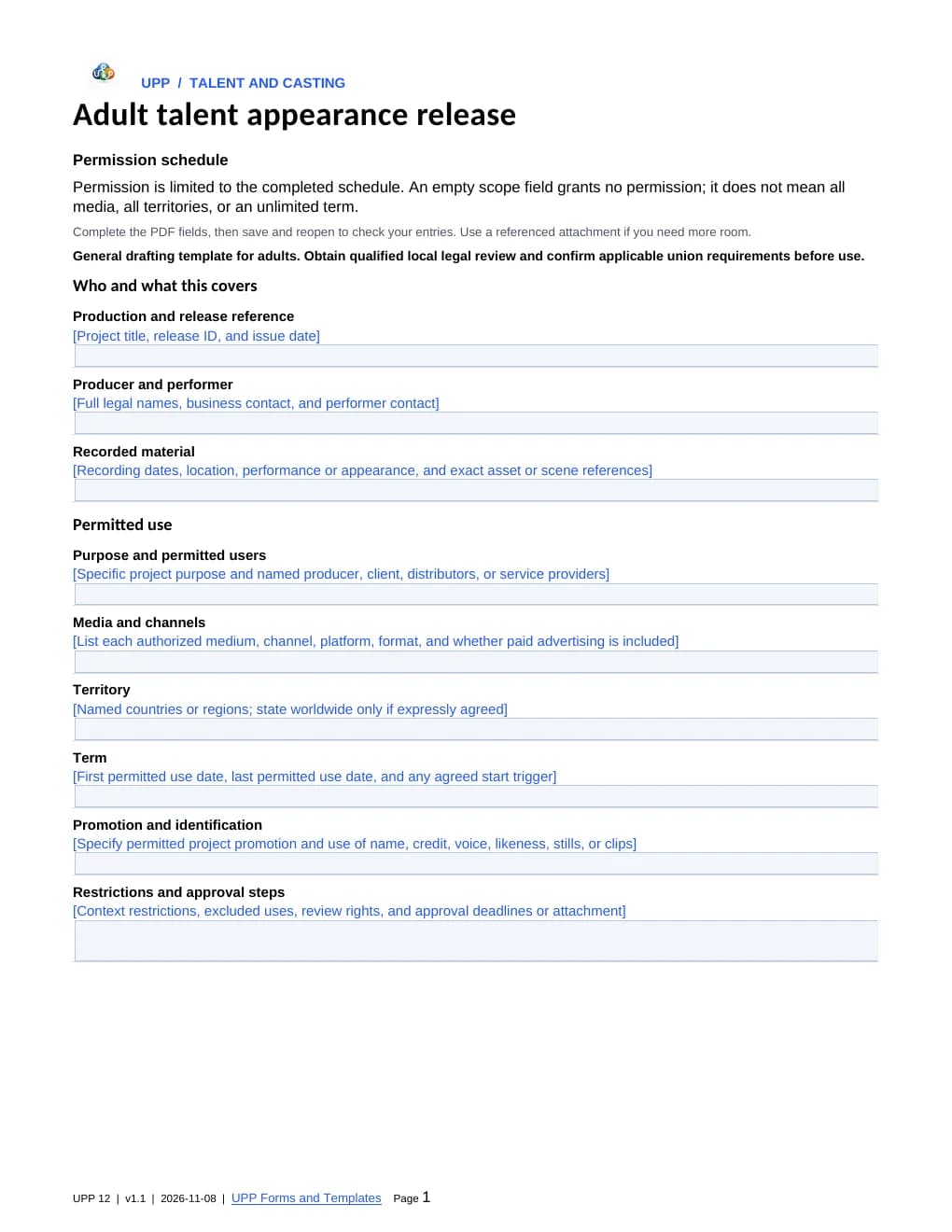
Record a specific permission to use an adult performer’s recorded appearance, with clear media, territory, term, payment, and use restrictions.
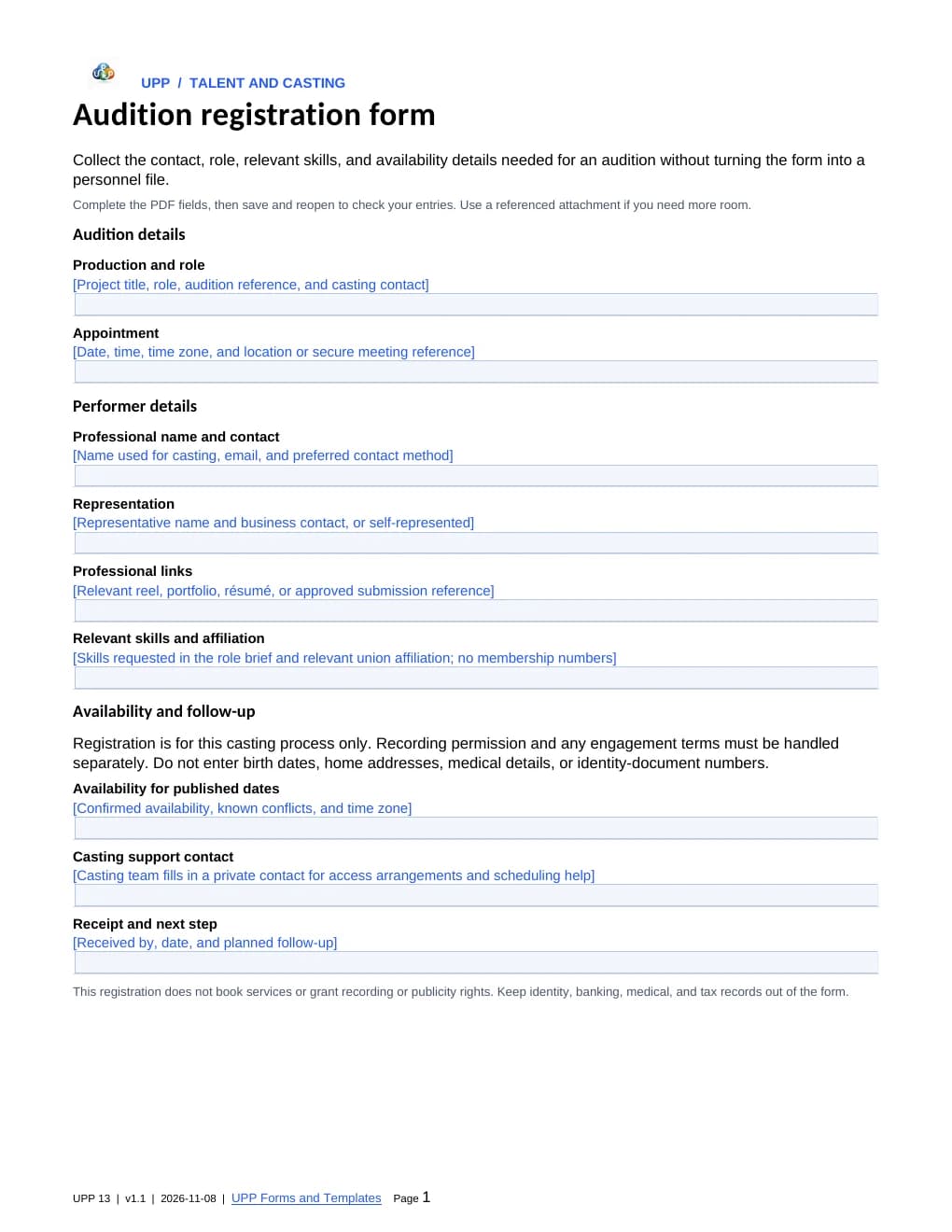
Collect the contact, role, relevant skills, and availability details needed for an audition without turning the form into a personnel file.
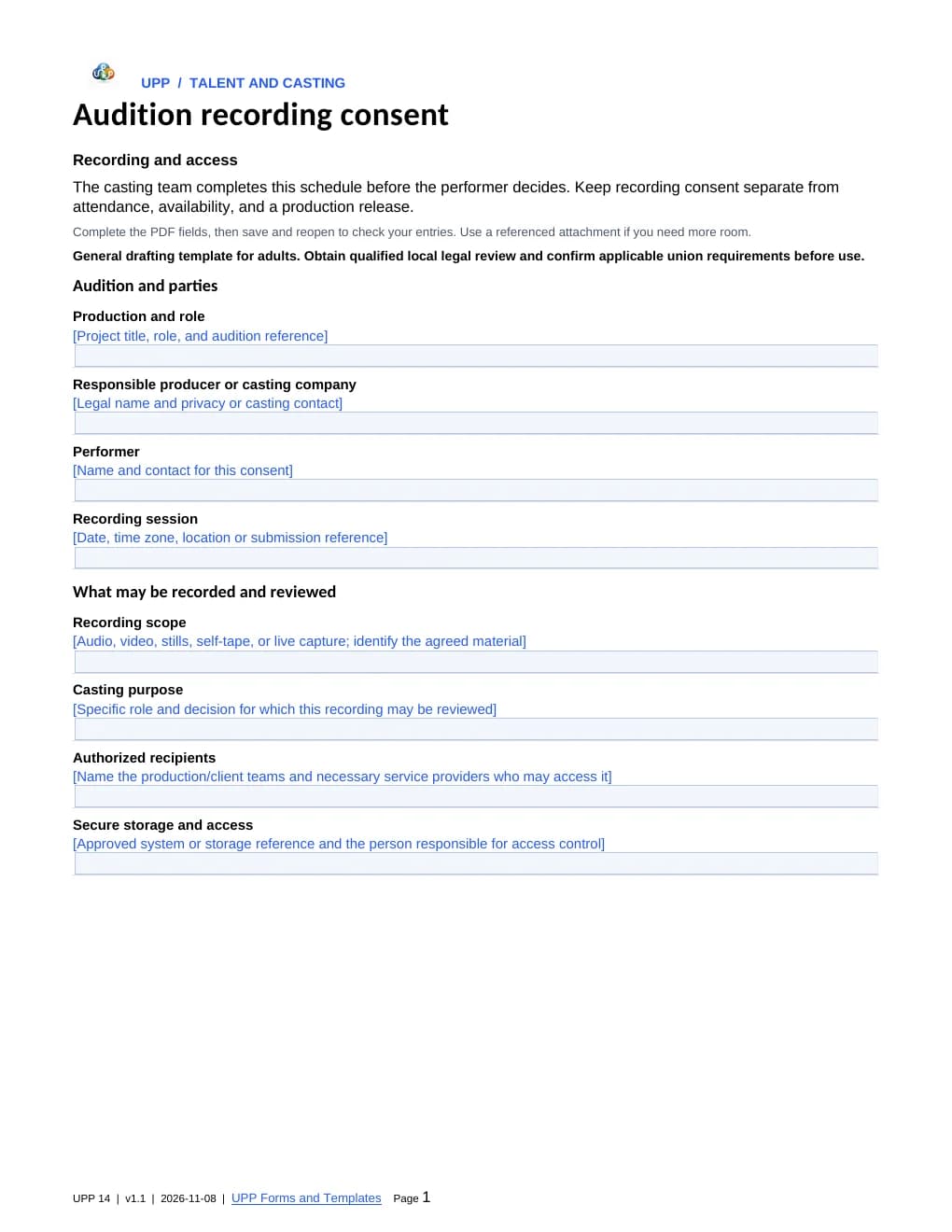
Agree how an adult audition recording may be captured, reviewed, shared with named casting recipients, and retained.
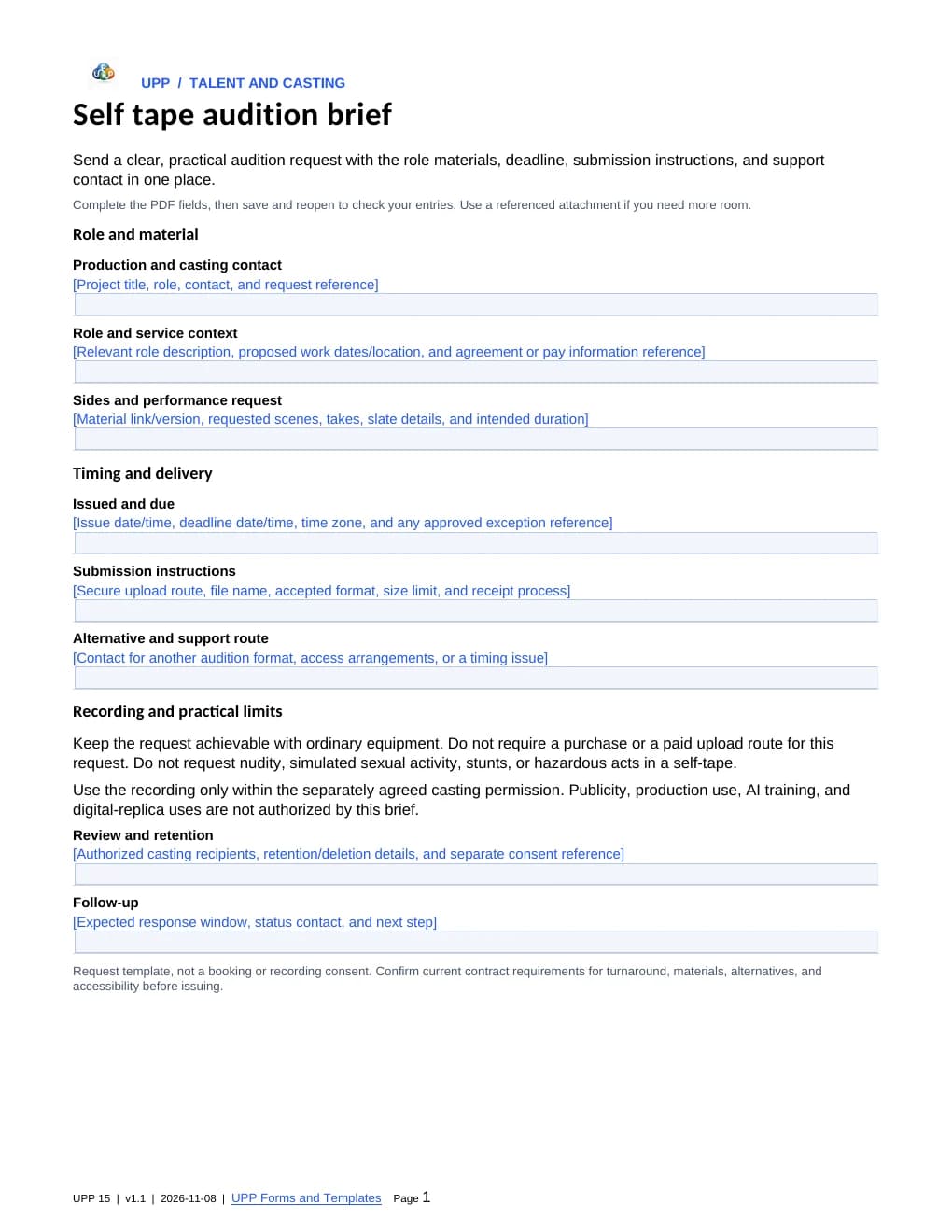
Send a clear, practical audition request with the role materials, deadline, submission instructions, and support contact in one place.
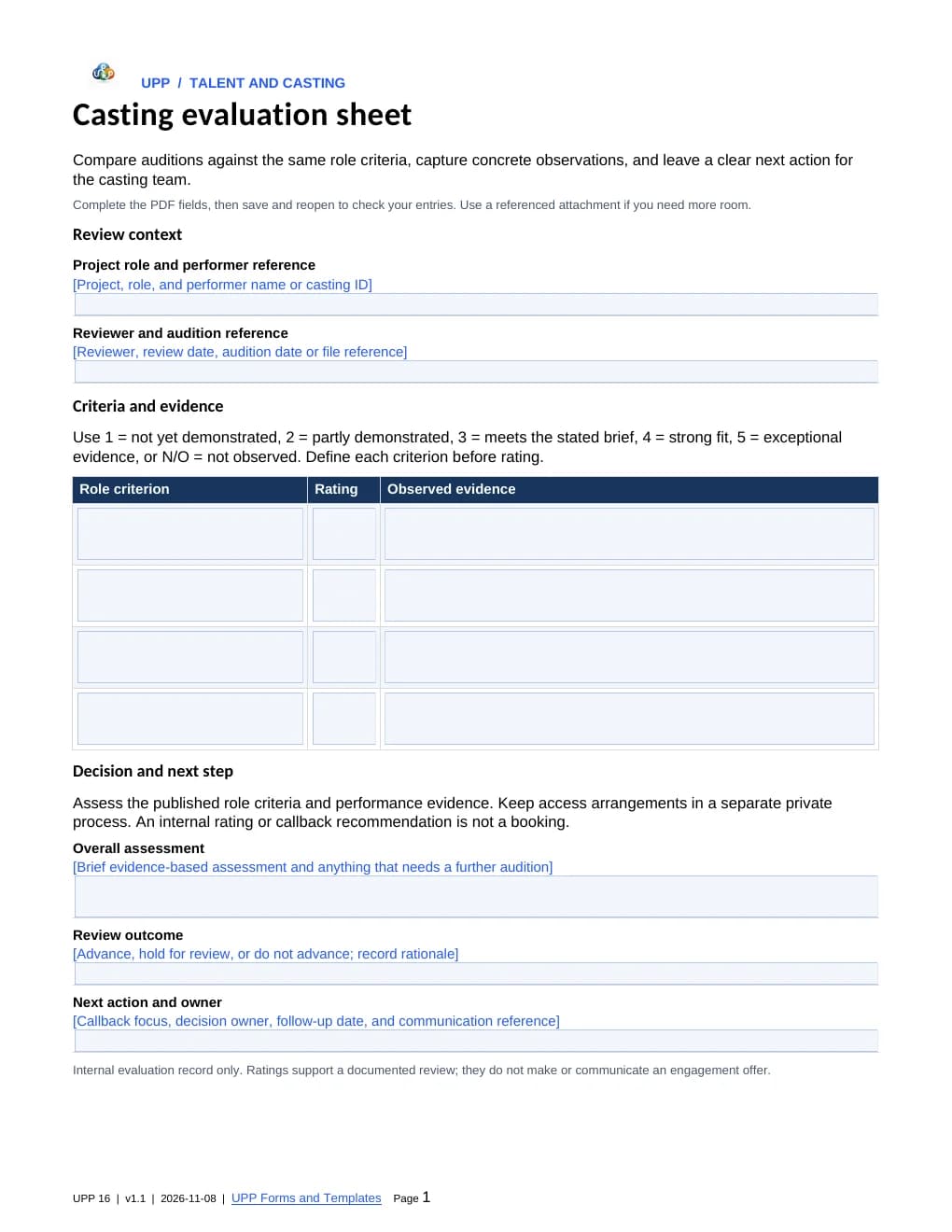
Compare auditions against the same role criteria, capture concrete observations, and leave a clear next action for the casting team.
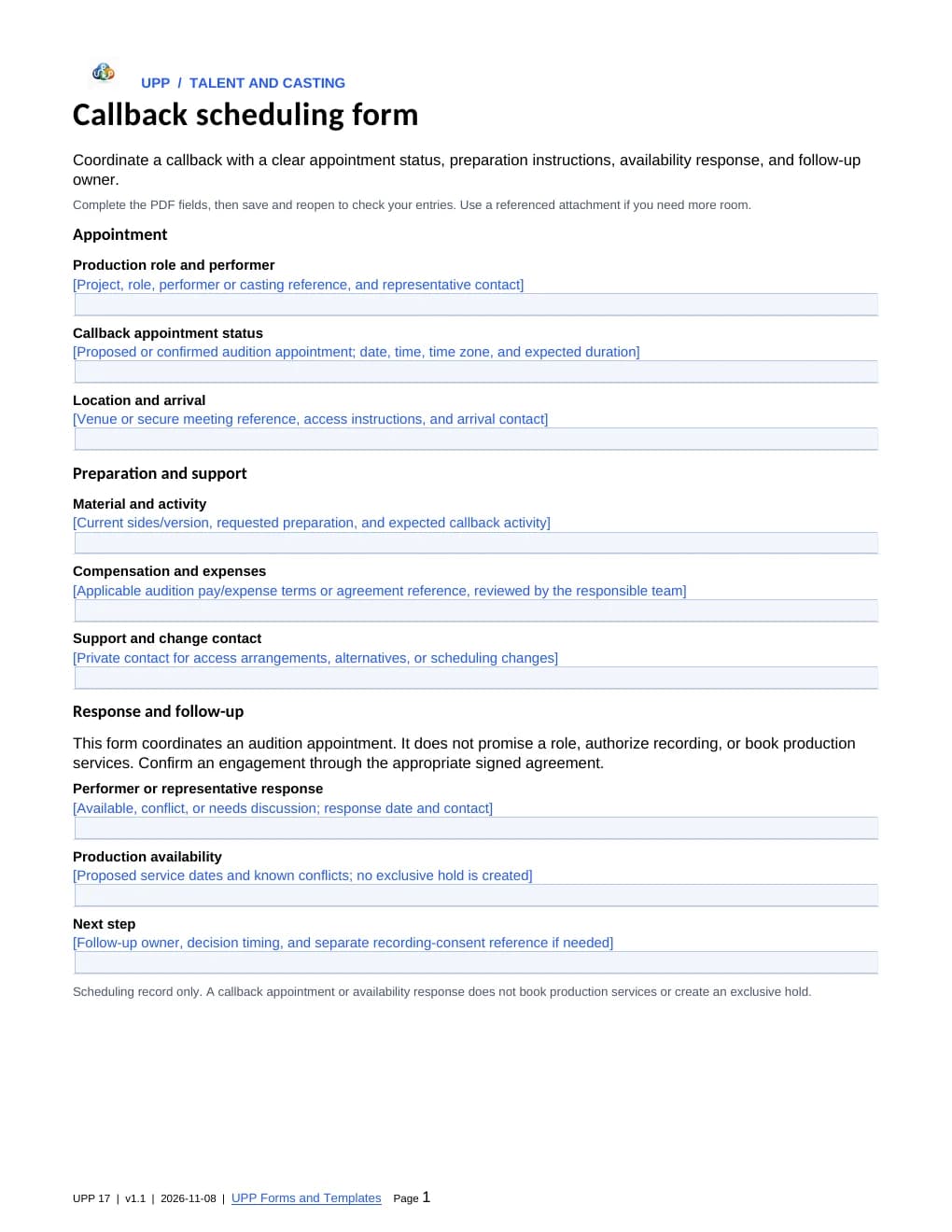
Coordinate a callback with a clear appointment status, preparation instructions, availability response, and follow-up owner.
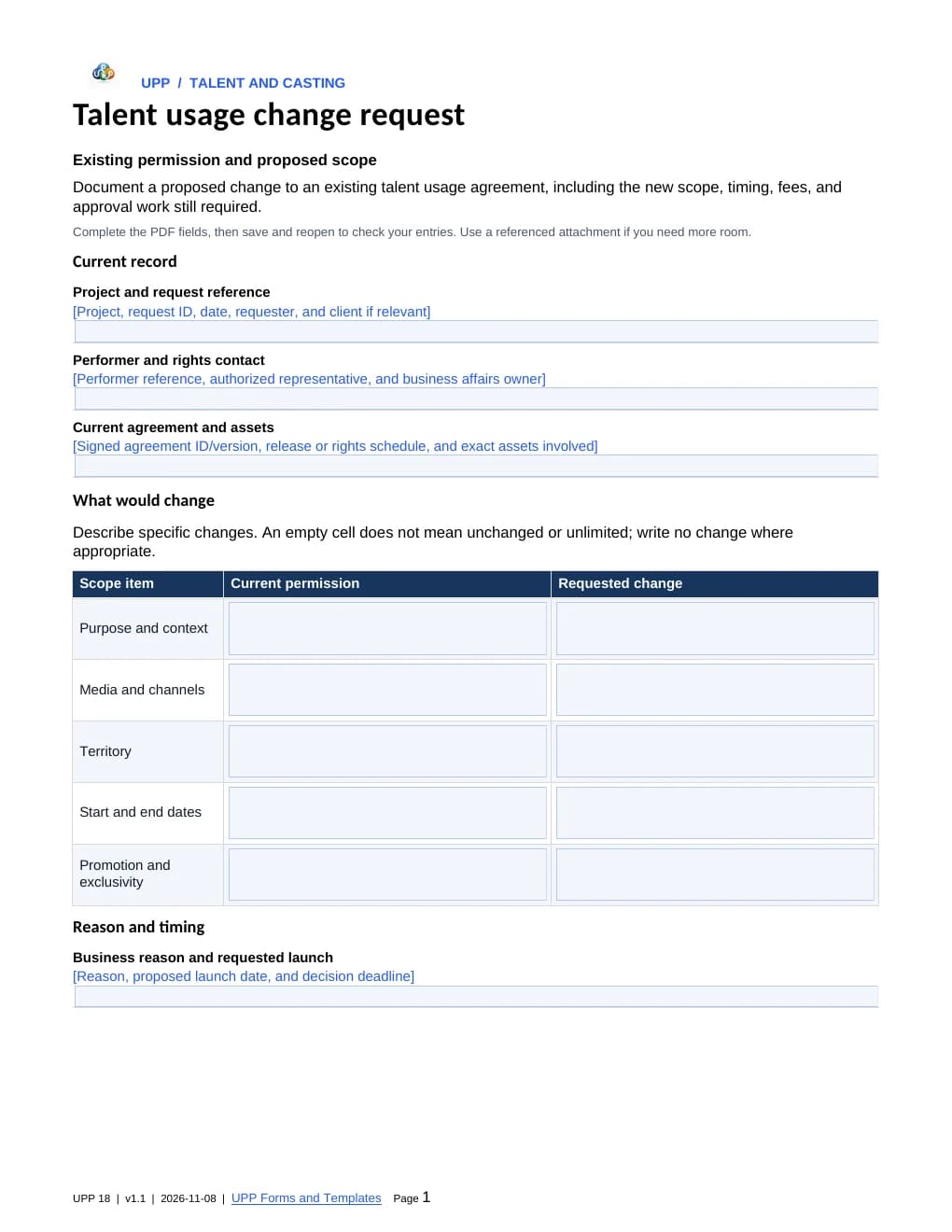
Document a proposed change to an existing talent usage agreement, including the new scope, timing, fees, and approval work still required.
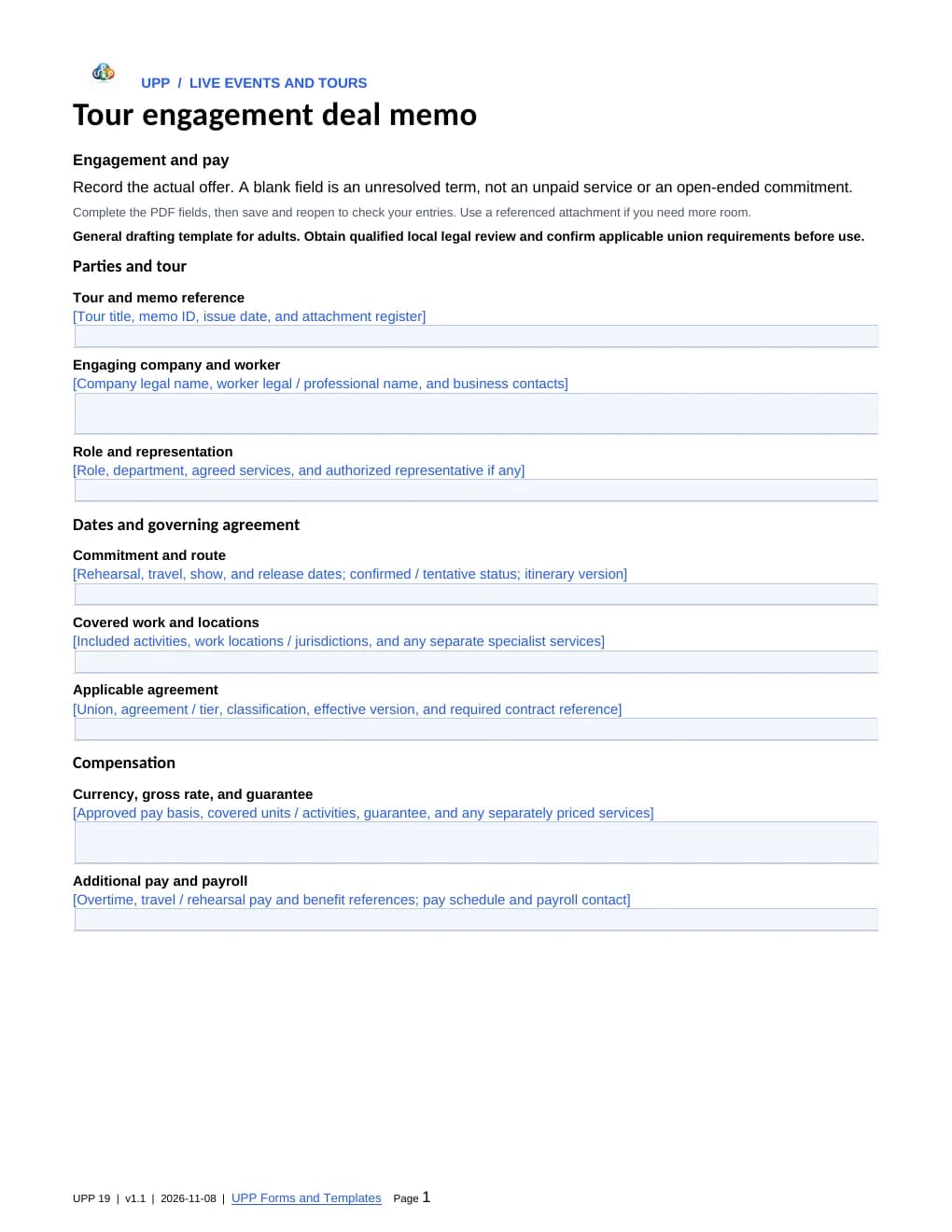
Agree the role, route commitment, pay, travel, and change process for an adult performer or crew member joining a tour.
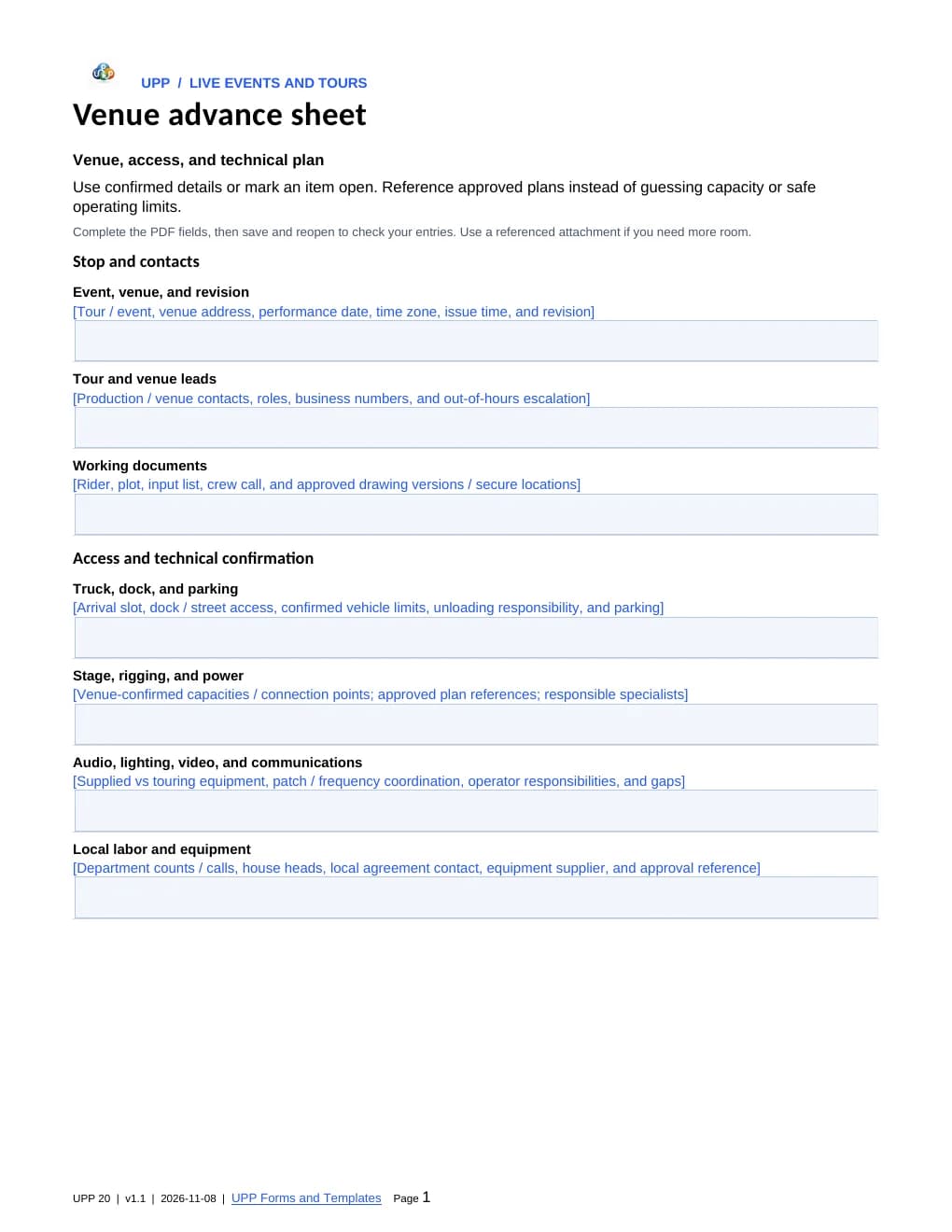
Turn the tour rider and venue response into one confirmed plan for access, technical needs, local labor, and show-day support.
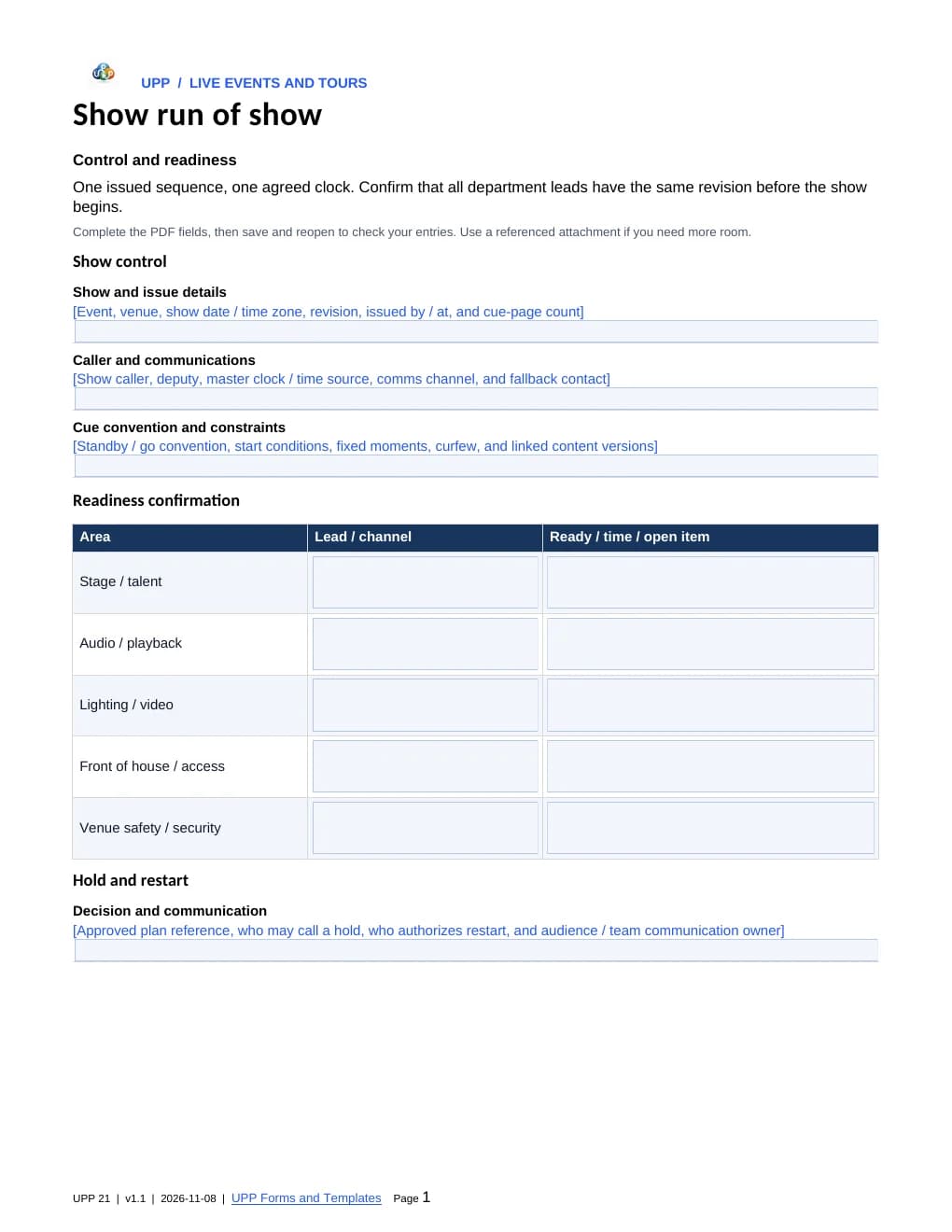
Give the show caller and department leads a clear cue sequence, shared clock, and record of holds and changes.
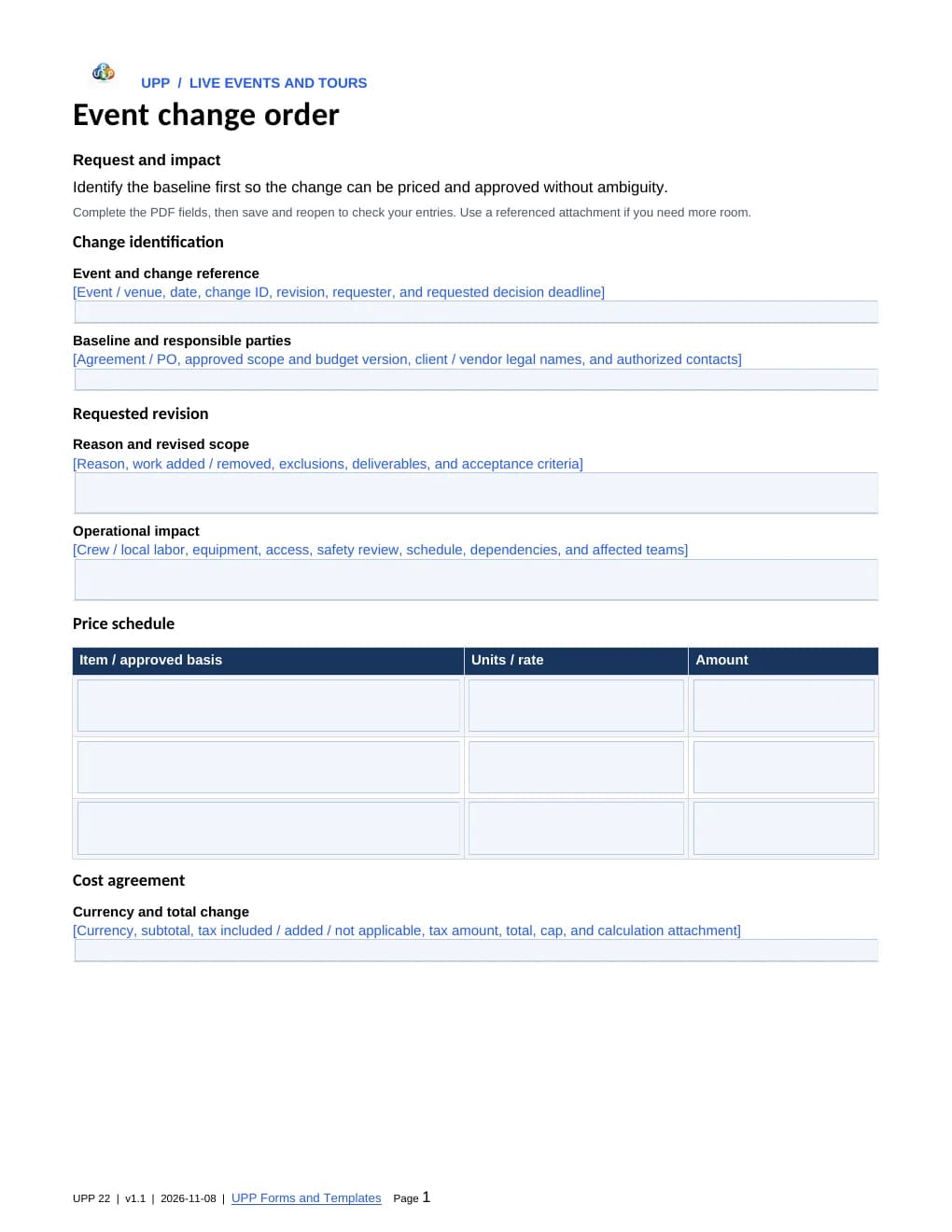
Capture a requested event change, its cost and schedule impact, and the people authorized to approve it before the revised work proceeds.
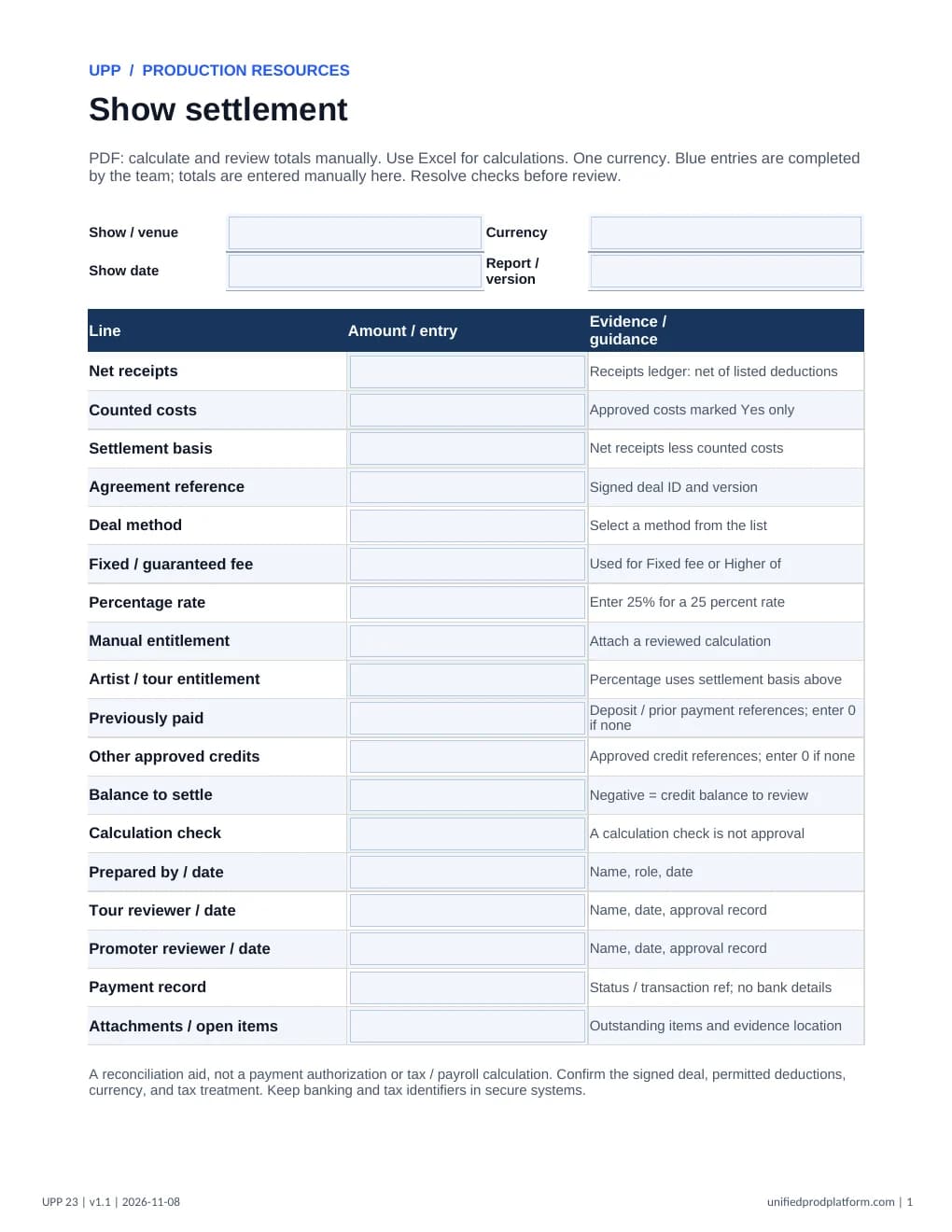
Reconcile a live show from documented receipts and approved costs to the agreed artist or tour entitlement and remaining balance.
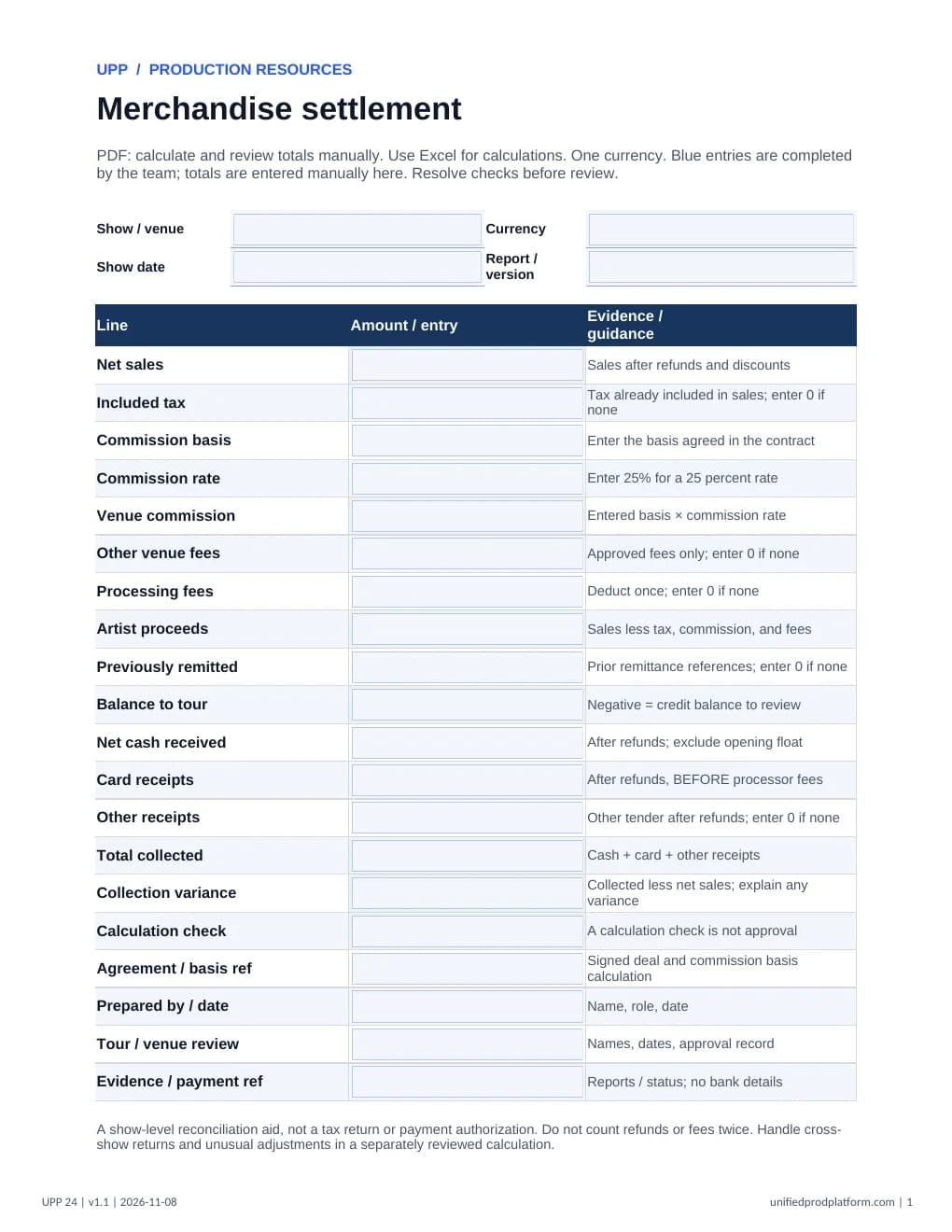
Close a merchandise stand with itemized net sales, the agreed venue commission basis, artist proceeds, and a cash / card reconciliation.
Complete the PDF fields, save a copy, and reopen it to check your entries. Use a desktop PDF reader if your browser does not save fields correctly. Use the Excel worksheets for calculations; PDF totals require manual calculation and review.
Use the project, date, owner, and reference fields to make handoffs easier to follow. Store sensitive records in your approved secure system.
Deal memos, releases, and consent forms need qualified local legal review before use. Confirm employment, tax, union, and local requirements for your production. Collection 1.3 · November 8, 2026.
UPP wording, branding, and layout are protected; fill the designated fields and use a referenced attachment for additional terms or space. PDF permissions and Excel protection deter routine editing but cannot prevent every copying tool. Read our content use permissions.
From the union
Find the right paperwork for the next step. Browse 43 forms for screen productions, touring, and live events, with direct official links and a note on when each is used. Filter by type of work, union, or production stage.
Sources reviewed November 8, 2026. Sample and older-edition notes appear with the relevant forms. Confirm your agreement and the required version with the union before completing paperwork.
43 official forms in 9 collections
Casting, engagement, and production records for theatrical projects. Some forms also cover television; use the version assigned to your agreement.
SAG-AFTRA marks several documents as samples. Ask your business representative for the version to complete and submit.
Full official collection for Theatrical production — opens SAG-AFTRA's website in a new tabWhen to use: While preparing the theatrical signatory packet, to identify performers engaged for the production.
Use the cast-list version for your agreement; short, student, and low-budget projects may have different paperwork.
When to use: At covered theatrical or television auditions, to record attendance and the audition's arrival, appointment, and departure times.
This is SAG-AFTRA's sample. Check the applicable audition process with your casting representative.
When to use: When checking the union membership status of the performers you plan to engage, as part of cast clearance.
SAG-AFTRA instructs users to download this fillable form and open it in a PDF reader. Confirm the receiving office for your production location.
When to use: When engaging a performer on a weekly basis under the theatrical agreement, to document the employment terms.
Sample for weekly engagements. Confirm the contract for the performer's category and the production's budget agreement.
When to use: When a covered production hires a principal performer who is not a SAG-AFTRA member and a Taft-Hartley report is required.
Confirm eligibility, supporting documents, and the filing deadline with SAG-AFTRA. Background and commercials reporting use different forms.
When to use: On each covered workday, to log performer work, meals, travel, and related time for review and signature.
Sample timesheet. Use the agreement-specific version supplied or accepted by your business representative.
When to use: When a performer is injured on set, to record the incident for SAG-AFTRA.
Follow the production's immediate response procedures and any separate employer or insurance reporting requirements.
Forms for commercial auditions, principal and extra engagements, nonmember reporting, and changes to use.
Match the form to the Commercials or Audio Commercials Contract and the performer's category. Confirm current filing instructions with the Commercials Department.
Full official collection for Commercials and audio commercials — opens SAG-AFTRA's website in a new tabWhen to use: For covered in-person or live virtual commercial auditions and interviews, to record the audition and callback details.
SAG-AFTRA's Exhibit E guidance excludes self-tape auditions. Confirm the current submission process with the union.
When to use: When conducting auditions covered by the Audio Commercials Contract, to record the performer's audition attendance.
Check that the audio agreement applies before choosing this form.
When to use: When engaging an on-camera or off-camera principal performer under the Commercials Contract.
Use the official employment contract to capture session terms and intended use. Confirm applicable terms and rates for the work date.
When to use: When engaging an extra performer under the Commercials Contract, to document the engagement and work times.
This form is for extras. Confirm the appropriate contract if the performer's category changes.
When to use: When reporting a nonmember's covered commercial engagement to SAG-AFTRA.
Select the correct production category and confirm the deadline and supporting documents. The union identifies this as a collectively bargained form.
When to use: When the proposed commercial work involves AI or a digital replica and the union's rider applies.
Review the proposed use, consent, and compensation with the union before recording or using a replica.
When to use: When commercial rights are being transferred and the parties need to document the associated contractual responsibilities.
Confirm the union's transfer process before completing the transaction. Audio commercials have a separate transfer form.
Engagement applications, recording riders, and contribution reports for Equity actors and stage managers.
Equity agreements have different eligibility and reporting rules. Confirm the production's agreement with the regional office before selecting paperwork.
Full official collection for Live theatre — opens Actors’ Equity Association's website in a new tabWhen to use: When an eligible community or educational theatre seeks Equity approval to engage an actor or stage manager for a specific production.
The official page explains eligibility and links to the application. NYC, Chicago, Los Angeles, and San Francisco require express written Equity consent.
When to use: When arranging a cast album recording involving Equity performers and the applicable agreement calls for this rider.
Confirm the rider and recording terms with Equity before the recording session.
When to use: During weekly payroll reporting when Equity directs the production to use its standard contribution report.
Use the rates and contribution rules for the applicable agreement. The workbook does not establish which agreement covers the production.
When to use: During weekly contribution reporting for a production covered by the League of Resident Theatres agreement.
Equity lists this workbook specifically for LORT. Confirm the applicable contribution rates before completing it.
Performer paperwork under ACTRA's Independent Production Agreement. British Columbia has a separate agreement and forms.
ACTRA's 2025–2027 IPA page still links to some 2022–2024 form editions. Those are identified below; confirm the accepted version with the local branch.
Full official collection for Film, television, and digital media — opens ACTRA's website in a new tabWhen to use: Before engaging a performer who needs an ACTRA work permit for a production covered by the IPA.
Confirm the performer's permit category and approval with the local branch. This application excludes commercial productions.
When to use: When documenting a performer's role, engagement dates, compensation, and use terms under the IPA.
ACTRA's authorized 2025–2027 form. Confirm the engagement and any riders with the branch before signing.
When to use: For an IPA performer's workday, to record calls, work, meals, and other time needed for reporting and payroll.
The official catalog links this 2022–2024 edition. Confirm the accepted form and current rules with ACTRA.
When to use: At auditions for an IPA production, to capture performer attendance and audition timing.
The official catalog links this 2022–2024 edition. Check the current audition requirements and accepted form with the branch.
When to use: When appointing the person responsible for hiring performers on an IPA production, before principal photography begins.
This declaration must be properly executed and sworn. Arrange the required formalities and delivery to ACTRA.
When to use: When a minor is engaged on an IPA production and the parent or guardian needs to complete the agreement's declaration.
Confirm the full minors packet with ACTRA, including any chaperone, education, medical authorization, and trust requirements.
Pre-production, engagement, payment, and audition paperwork linked from ACTRA's National Commercial Agreement directory.
The directory links to earlier dated forms and a 2025–2026 agreement renewal. Confirm the agreement now in force, signatory status, rates, and accepted forms with ACTRA before use.
Full official collection for Canadian commercial production — opens ACTRA's website in a new tabWhen to use: Before a covered commercial shoot, to notify the local ACTRA branch of the production, intended use, and planned performer work.
The official catalog links a 2023–2024 file. Confirm the filing lead time and accepted edition with the branch.
When to use: When engaging a performer for a commercial covered by the NCA, to record the booking and commercial use details.
The official catalog links a 2023–2024 file. Ask ACTRA to confirm the form and terms that apply to the engagement.
When to use: When reporting and remitting performer session payments for a covered commercial.
The official catalog links a 2024–2025 file with printed rates and deductions. Confirm current amounts and deadlines before calculating payments.
When to use: When reporting and remitting residual payments tied to a commercial's use or renewal cycle.
The official catalog links a 2023–2024 file. Confirm current use fees, deductions, and remittance deadlines with ACTRA.
When to use: When obtaining parental consent for minors auditioning under the NCA process.
The official catalog links a 2022–2023 file. Confirm the accepted form and the separate paperwork required if the child is booked.
Musician contract forms for commercial announcements, independent productions, and sound recordings.
These are Canadian forms. Confirm coverage, any required letter of adherence, current rates, and filing with the AFM/CFM local before the session.
Full official collection for Musician recording and media — opens AFM / Canadian Federation of Musicians's website in a new tabWhen to use: When engaging musicians to record music for a Canadian commercial announcement under the applicable CFM agreement.
Confirm the covered media and any reuse or new-use reporting with the local.
When to use: When engaging musicians for a production covered by the musicians' Independent Production Agreement.
This is the CFM IPA form. Confirm the production's agreement and any required adherence paperwork with CFM.
When to use: When documenting musicians' covered sound-recording sessions in Canada and any applicable reuse or new-use payments.
The official directory links the 2026 form. Confirm the recording category and filing requirements with the local.
Engagement contracts and reporting for concerts, corporate events, and traveling musicians, from AFM Local 47's live-performance collection.
The T-2 and LS-1 are AFM forms; the LA-47, wage report, and work-dues report are Local 47 paperwork. Confirm jurisdiction and whether a collective agreement applies before selecting a form. Recording or streaming needs separate union clearance.
Full official collection for Live musicians and traveling engagements — opens AFM / Canadian Federation of Musicians's website in a new tabWhen to use: When booking musicians for a traveling engagement, to document the venue, schedule, personnel, and agreed compensation.
The official collection still links the August 2007 revision. Confirm the accepted form and any touring agreement or pension paperwork with the responsible AFM local.
When to use: When engaging musicians for a local live event within AFM Local 47's jurisdiction and the union directs you to use its casual contract.
Local 47 only. Confirm the event's coverage, wage scale, benefits, and any required participation agreements with its Live Performance Department.
When to use: For a covered U.S. local single engagement requiring an AFM agreement and pension remittance details for the musicians.
Not for use in Canada. This packet is hosted by the AFM-EP Fund and marked June 2025; confirm the accepted edition and contribution rate with the local or Fund.
When to use: When reporting covered rehearsals and performances to Local 47, including musician wages and the related benefits and work dues.
Use the rates for the applicable collective agreement or local scale. Confirm the workbook and remittance instructions with Local 47 before filing.
When to use: When Local 47 requires its work-dues report for a live engagement, with the associated pension and health-and-welfare contribution details.
Local 47 only. The posted form includes older contact details; confirm the current submission destination and payment instructions with the local.
Staffing forms used to communicate a touring production's local crew requirements for load-in, performances, and load-out.
These forms support the Pink Contract process. They do not replace the tour's labor agreement, individual passport, or any required road card. Confirm filing and changes with the Stagecraft Department.
Full official collection for Touring stage crews — opens IATSE's website in a new tabWhen to use: At the start of a Pink Contract tour, when the head carpenter establishes the local staffing required by department for each stage of the show call.
Follow IATSE's Yellow/White Card instructions for signatures, timing, and revisions. Reducing the established staffing numbers requires Stagecraft Department permission.
When to use: When the wardrobe supervisor documents a Pink Contract tour's wardrobe, hair, and makeup staffing, day work, and specialist needs for receiving venues.
The official collection links the October 2026 fillable form. IATSE publishes card information for local staffing; follow its instructions about optional contact details.
Registration, audition, tour planning, and remittance forms for professional theatre companies working under the CTA with PACT.
These forms belong to the 2024–2027 CTA process. Independent theatre and other agreements have separate paperwork. Confirm coverage with PACT or your Equity business representative, including overseas-tour riders.
Full official collection for Canadian theatre and tours — opens Canadian Actors’ Equity Association's website in a new tabWhen to use: Before a CTA production begins its engagements, to register the production, artists, rehearsal and performance dates, and any planned tour.
The form is dated January 2025. Check the registration deadline and identify any circumstances needing prior approval with your business representative.
When to use: At auditions covered by the CTA, to record the audition setup and each artist's attendance and in/out times.
Use the CTA audition conditions and filing instructions. This is Canadian Equity paperwork; U.S. Actors' Equity has a separate process.
When to use: While planning a CTA tour, to map departure and arrival times, travel, venues, and hotels for review by Equity and the company liaison.
Available as a PDF or editable Excel workbook. Confirm filing timing, U.S. tour conditions, and any overseas rider with your business representative.
When to use: When preparing the CTA production's artist deductions and required remittances to Canadian Equity.
Use the current CTA remittance instructions and applicable rates. Confirm reporting periods and accepted submission methods with Equity.
These documents remain on the issuing union's or benefit fund's website. They are separate from the original UPP downloads above.
Some contract packets and touring credentials come directly from the union. These official guides explain where to start and who supplies the paperwork.
Actors’ Equity Association
When to use: When planning an Equity tour and establishing which agreement and contract packet apply to its actors and stage managers.
This overview is public; agreement documents linked in Equity's member portal require an Equity login. Producers can request the current packet from Equity. The overview still lists a September 2026 expiry, so confirm the terms now in force.
Official guidance : U.S. theatrical touring agreements — opens in a new tabActors’ Equity Association
When to use: When engaging Equity actors or stage managers for trade shows, product launches, conventions, or other promotional live performances.
This overview is public; its rulebook link opens Equity's member portal and requires an Equity login. Producers can request paperwork from the regional office. The overview lists an older agreement period, so confirm the terms now in force.
Official guidance : Corporate performances and live events — opens in a new tabIATSE
When to use: Before a touring crew member starts work, to confirm the production's Pink Contract, tier, and required touring credentials.
The Stagecraft Department supplies the contract and issues passports at the employer's request. Obtain any required road card through the member's local. This link opens official guidance.
Official guidance : Pink Contracts, passports, and road cards — opens in a new tabFrom the issuing agency
Get government forms and instructions directly from the agency. These links open the official source; UPP templates do not replace these forms. Your responsible reviewer should confirm the edition and any additional state, provincial, or local requirements.
United States · USCIS
Employment Eligibility Verification form and instructions from USCIS.
Opens the official agency website in a new tab.United States · IRS
Employee's Withholding Certificate and current IRS instructions.
Opens the official agency website in a new tab.United States · IRS
Request for Taxpayer Identification Number and Certification.
Opens the official agency website in a new tab.Canada · Canada Revenue Agency
Federal, provincial, and territorial TD1 forms, organized by tax year.
Opens the official agency website in a new tab.Québec · Revenu Québec
Form TP-1015.3-V and the current official source deductions return.
Opens the official agency website in a new tab.