Commercial production
A commercial is never one payment: inside UPP's end-to-end commercial talent and residual record
Editorial date · · 13 min read · Unified Production Platform
Published · Last reviewed
Why fragmented commercial talent tools break down after wrap—and how UPP keeps Campaign Studio, SAG-AFTRA estimates, Completion Reports, Control Board, 6-stage session payroll, residual processing, vendor AP, MY UPP, and UPPilot on one governed record.
A commercial is never one payment. It begins with a session fee, then becomes fixed 13-week holding fees, multi-market residuals, guarantee offsets, pension and health contributions, and union batch statements—cycle after cycle for as long as the spot runs.
The 3-minute-and-46-second walkthrough above follows one fictional campaign, Summit Trail — Fall 2026 Launch (a 30-second spot and a 15-second cutdown), across every stage of that lifecycle on one governed record. Below is a detailed look at why fragmented commercial workflows break down after wrap and how UPP resolves each industry problem end to end.
Why commercial talent breaks—and how UPP resolves each failure mode
Crew payroll centers on hours, meal penalties, and daily rates within a pay week. Commercial talent payroll is contract-and-rights state stretched across months or years. Every downstream payment depends on upstream commercial facts staying intact: which spot version aired, its validated Ad-ID, the governing SAG-AFTRA Commercials Contract category, when fixed 13-week cycles started, any active guarantee balance, and whether airings match cleared rights.
When estimates sit in a bidding workbook, contracts in a shared drive, session payroll in one queue, and airings in a traffic sheet, downstream operators receive dollar totals stripped of the rules behind them. Here is how UPP resolves the seven core breakdowns on one record:
| Industry failure mode | What breaks in disconnected tools | How UPP resolves it |
|---|---|---|
| Brief-to-budget drift | Casting counts get retyped from pitch decks into spreadsheets whenever creative changes. | Campaign Studio generates storyboard + draft video, proposes performers with visible AI confidence, and waits for human approval. |
| Mismatched spot IDs | Creative, traffic, business affairs, and payroll maintain separate IDs for :30 and :15 edits. | One Selected Commercial Slot holds Details, Performers, Estimates, Contracts, Rights, and Links with live Ad-ID validation. |
| Wrap-to-residual amnesia | Final cast, guarantees, and cycle-one dates get buried in static wrap PDFs. | Shoot actuals flow into a Final Completion Report, generating Pattern A fixed 13-week cycles through MPU. |
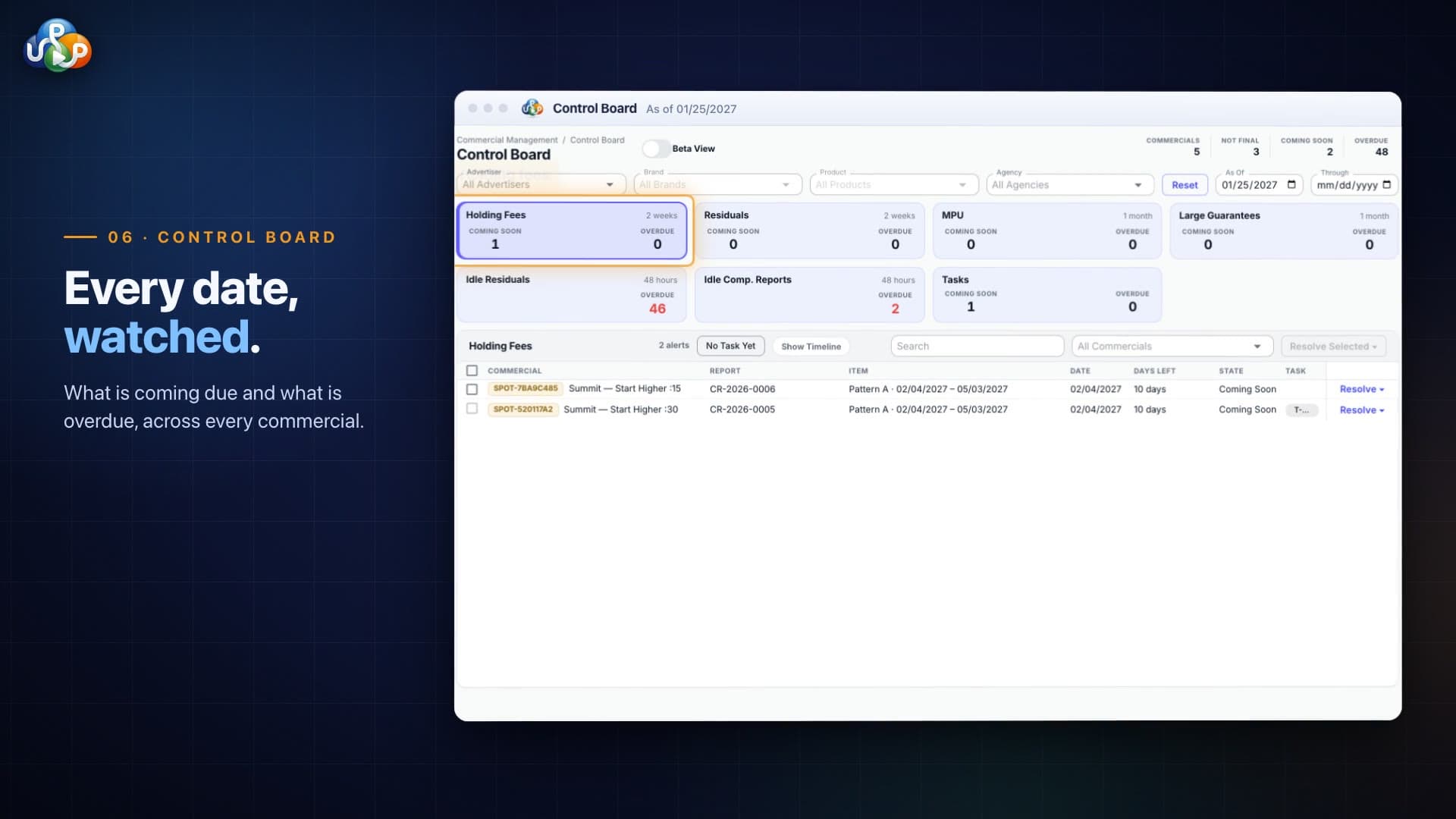
| Missed holding fees & idle bottlenecks | Manual calendars miss holding deadlines, risking exclusivity loss and union late penalties. | Control Board watches 7 live queues—Holding Fees, Residuals, MPU, Large Guarantees, Idle Residuals (>48h), Idle Comp. Reports (>48h), and Tasks. |
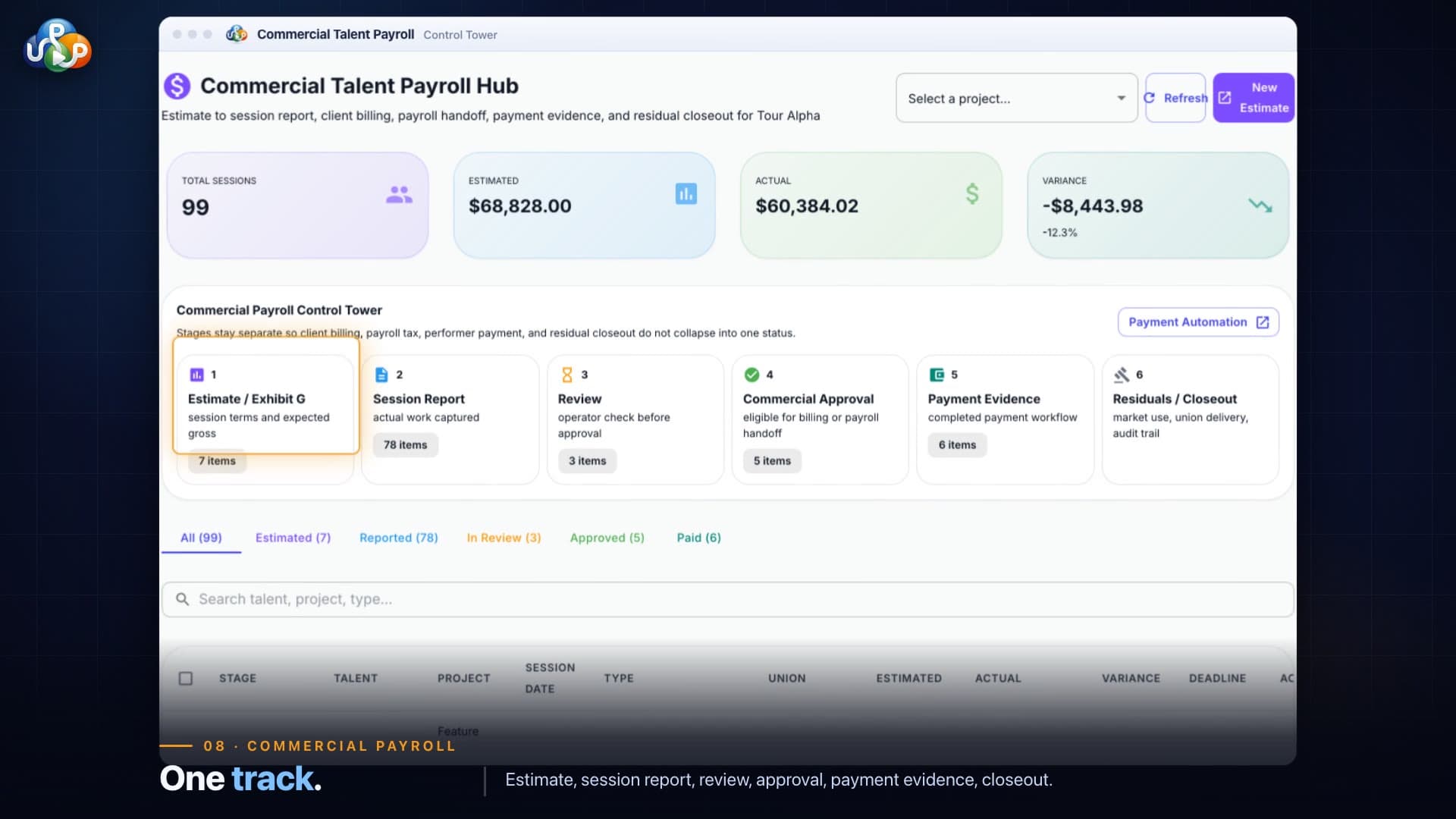
| Collapsed payroll statuses | Legacy queues blur session review, client billing approval, and bank settlement into one flag. | The 6-stage Commercial Payroll Control Tower separates Estimate/Exhibit G, Session Report, Review, Commercial Approval, Payment Evidence, and Closeout. |
| Unverified airings & overpayments | Residuals run without confirming clearance or crediting prior session fees, holding fees, and guarantees. | Network Clearance, Trafficking, and Market Use triggers drive performer-by-performer Residual Processing with SES/HF APP crediting, P&H, and Recorded locks. |
| Worker blind spots & split AP | Performers chase payroll by email while production vendors run in a separate AP tool. | Vendor Payments settle from segregated client funding accounts on the same platform; Talent 360, HAND ID, MY UPP, and UPPilot give self-service clarity. |
Inside the 3:46 walkthrough—chapter by chapter
Use this map to jump directly to the workflow stage most relevant to your team:
| Time | Chapter | What happens on one UPP record |
|---|---|---|
00:24 | 01 · Campaign Studio | Plain-language brief generates storyboard, watermarked draft video, and 4 chapters: Create, Budget, Make, Air. |
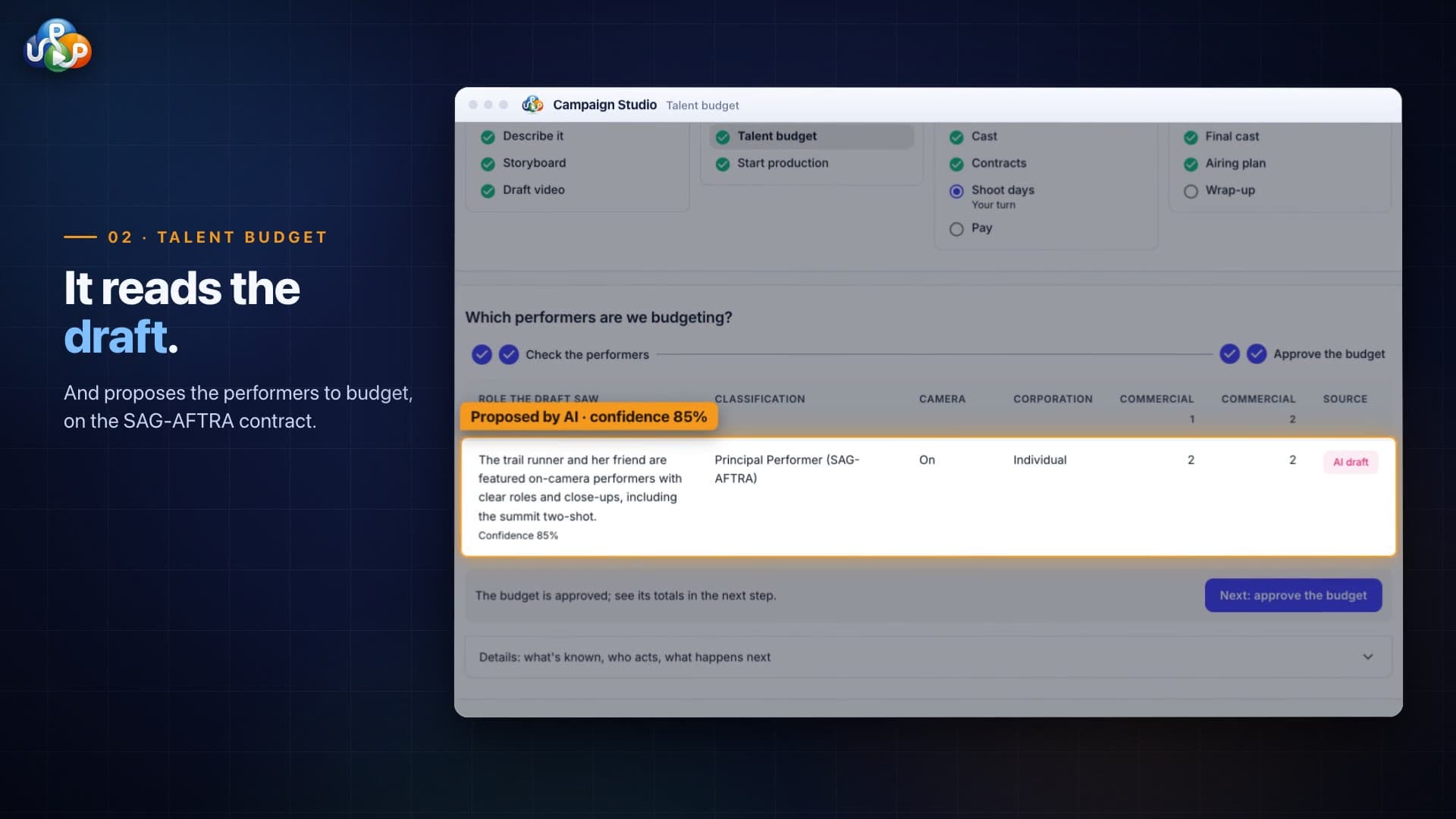
00:40 | 02 · Talent Budget | AI reads the draft spot, proposes SAG-AFTRA performers with confidence score, and waits for human approval. |
00:51 | 03 · Definitions & Contracts | Each spot (:30, :15) is defined once; session estimates and Exhibit 1 contracts hang off that definition. |
01:06 | 04 · Residual Estimate | Planned media buys are priced per commercial—wages, employer taxes, P&H, and handling—before airing. |
01:15 | 05 · Completion Report | Post-shoot actuals become the master record: final cast, guarantees, and Pattern A fixed 13-week cycles through MPU. |
01:28 | 06 · Control Board | Portfolio dashboard monitors Holding Fees, Residuals, MPU, Large Guarantees, >48h Idle queues, and Tasks. |
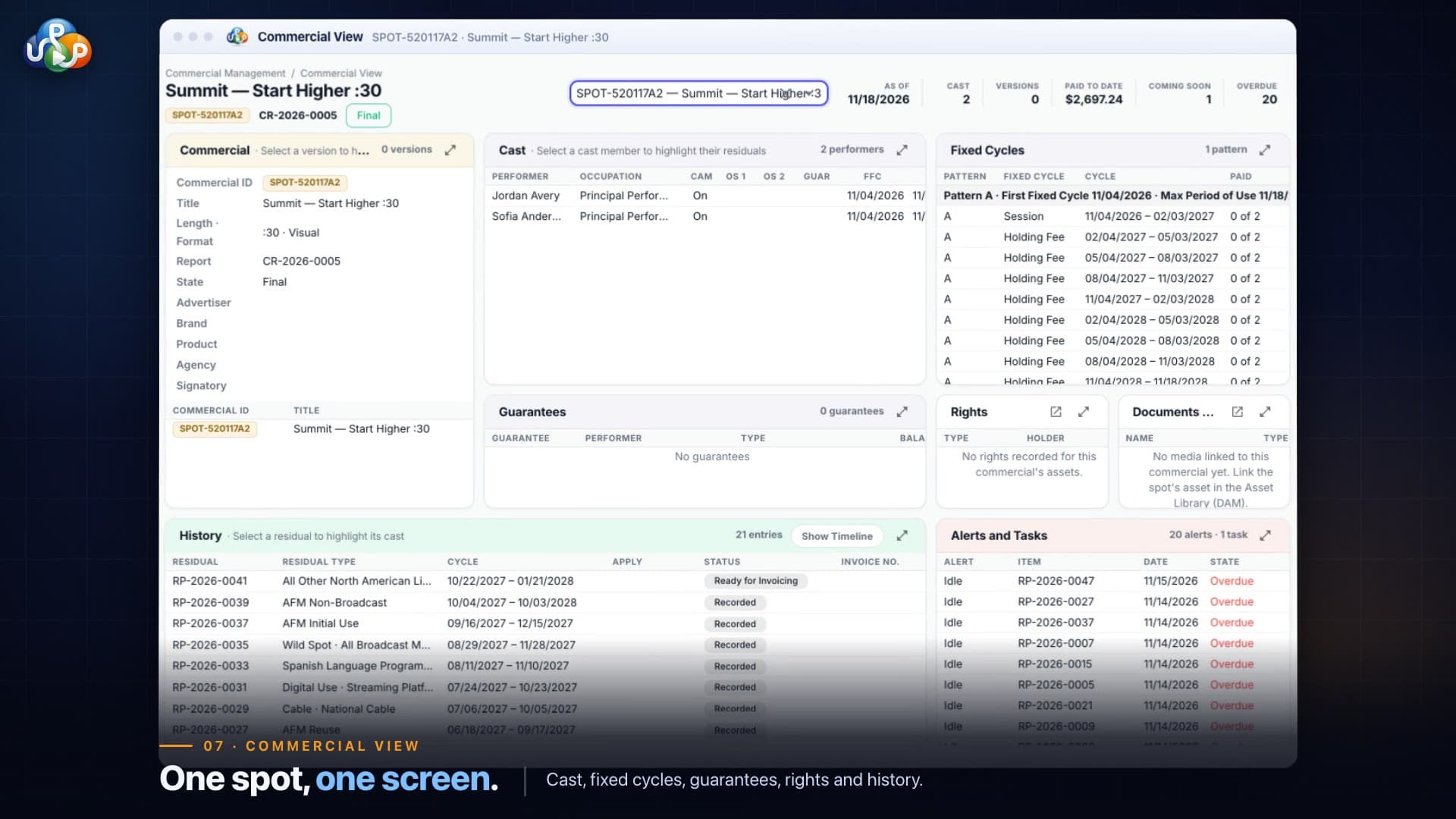
01:37 | 07 · Commercial View | One spot on one screen: Ad-ID, cast, fixed 13-week cycles, guarantees, rights, assets, history, and alerts. |
01:47 | 08 · Commercial Payroll | Sessions move through the 6-stage Control Tower with Estimate vs. Actual variance and separated statuses. |
01:58 | 09 · Network Clearance | Tracks each network's review (Under review to Approved) tied to advertiser, project, and assets. |
02:05 | 10 · Trafficking & Market Use | Follows Ad-IDs, deliveries, proof of performance, and verified market-use triggers feeding union batch delivery. |
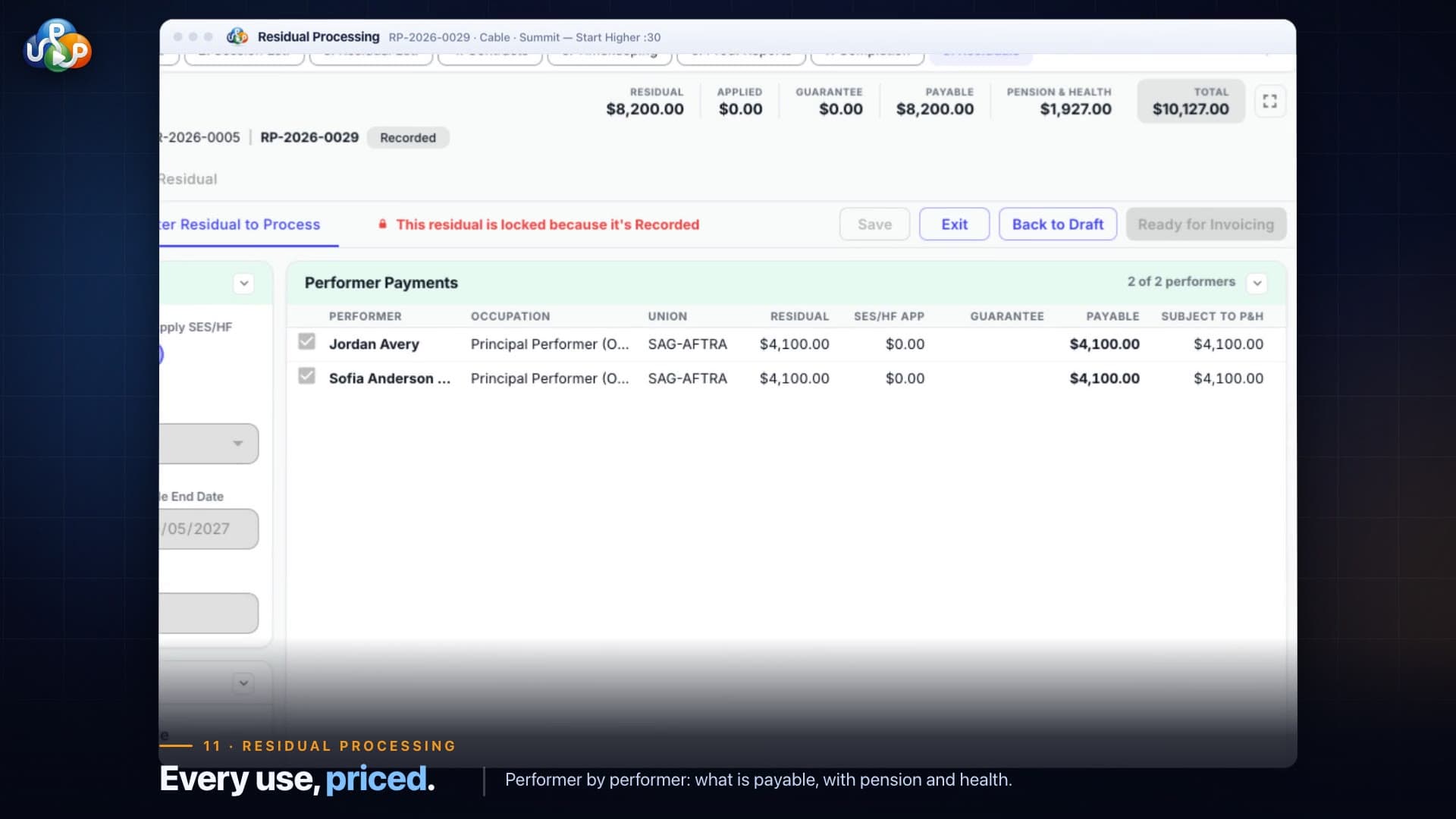
02:22 | 11 · Residual Processing | Prices each use performer by performer—gross residual, session/HF crediting, guarantees, payable, and P&H. |
02:31 | 12 · Vendor Payments | Production, post, and music invoices flow through Approvals, Payment Batch, and Settlement from client funding accounts. |
02:41 | Day One · Ad-ID, Talent 360, HAND ID | Live Ad-ID registry validation, unified performer profiles, and opt-in permanent public HAND ID attribution. |
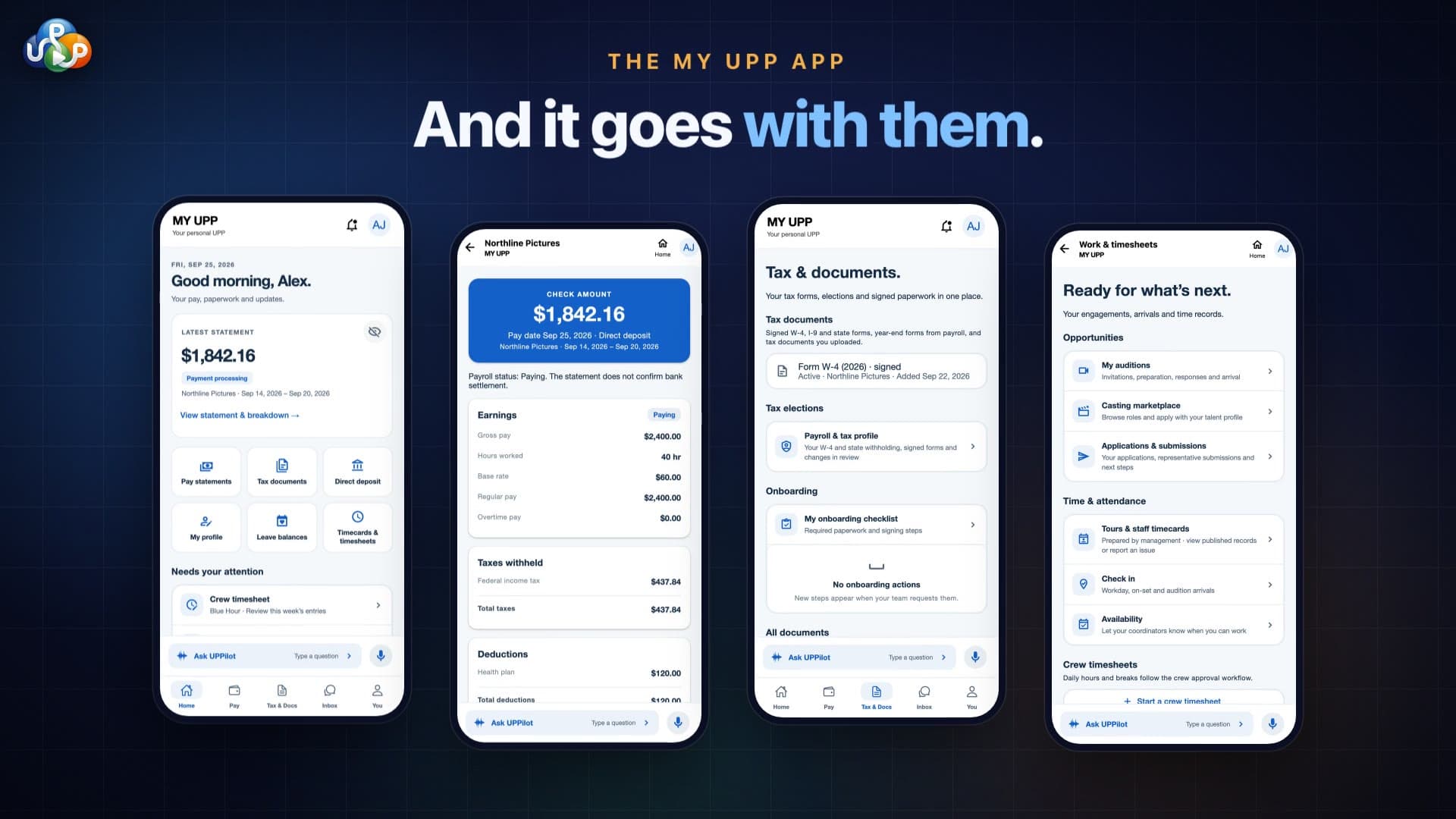
03:07 | Day One · MY UPP & UPPilot | Performer web/mobile pay statements, signed tax docs, auditions, timecards, and scoped plain-language Q&A. |
Pre-production: Campaign Studio, AI draft review, and single commercial definitions
From plain-language brief to human-approved talent budget
In Campaign Studio, a producer describes the campaign in plain words—such as a 30-second flagship spot and a 15-second cutdown. Campaign Studio builds the storyboard and watermarked draft video, then reads the draft to propose the performers needed on the SAG-AFTRA Commercials Contract with a visible confidence score and per-spot appearance counts.
Nothing locks silently: a human reviewer verifies the assumptions and clicks Approve the budget. Campaign Studio then guides the team through Create, Budget, Make, and Air, keeping cast, contracts, shoot days, pay, final cast, and the airing plan connected.
Governance boundary: As detailed in our AI-assisted commercial concepts rights guide, creative pre-visualization drafts stay strictly separated from performer likeness consent, union clearance, and public distribution approval.
One commercial definition powering estimates and contracts
Inside UPP's commercial talent workflows, commercial management follows an 8-step operational backbone: 1. Definitions → 2. Session Est. → 3. Residual Est. → 4. Contracts → 5. Timekeeping → 6. Prod. Reports → 7. Completion → 8. Residuals.
Each commercial (SPOT-520117A2 :30, SPOT-7BA9C485 :15) is defined once in a Selected Commercial Slot uniting DETAILS, PERFORMERS, ESTIMATES, CONTRACTS, RIGHTS, and LINKS with live Ad-ID validation (Validate & Record):
- Session estimates itemize performer wages, employer payroll taxes, pension and health, and handling fees under the applicable SAG-AFTRA rate period. Teams modeling quick pre-bid scenarios can also use UPP's free SAG-AFTRA commercial calculator, covered in our all-in commercial estimate field note.
- Residual estimates price planned wild-spot, cable, or streaming runs per commercial before media commitments lock.
- Performer contracting tracks every Exhibit 1 offer and contract on the slot through
Executed, keeping estimates, accepted offers, and signed contracts distinct.
Post-shoot continuity: Completion Report, Control Board, and Commercial View
The Completion Report as the master operational record
After wrap, shoot actuals flow directly into the Completion Report (CR-2026-0005, CR-2026-0006). Once marked Final, it becomes the authoritative master record—locking final cast, negotiated guarantees, and Pattern A fixed 13-week holding-fee cycles laid out automatically through Maximum Period of Use (MPU).
Control Board: seven live deadline and exception queues
Instead of manual calendars, UPP's Control Board watches every active commercial across seven live queues—Holding Fees, Residuals, MPU, Large Guarantees, Idle Residuals (>48h), Idle Completion Reports (>48h), and Tasks—filterable by Advertiser, Brand, Product, Agency, and As-Of Date with Show Timeline and one-click Resolve.
Commercial View: one spot, one screen
When business affairs, payroll, or a client auditor inspects one commercial, Commercial View puts the entire dossier on one screen: validated Ad-ID, interactive Cast (clicking a performer highlights their residuals), every Pattern A 13-week fixed cycle with live PAID counts (0 of 2, 2 of 2), Guarantees, Rights, Asset Library (DAM) links, full History timeline, and active Alerts and Tasks.
Six-stage session payroll, clearance, trafficking, residuals, and vendor AP
The six-stage Commercial Payroll Control Tower
UPP's Commercial Talent Payroll Hub tracks total sessions, estimated gross, actual gross, and variance, routing every session through six explicit stages inside the Commercial Payroll Control Tower:
- 1. Estimate / Exhibit G: Session terms and expected gross captured before wrap.
- 2. Session Report: Actual on-set work recorded against the shoot day and performer.
- 3. Review: Operator verification before anything advances to approval.
- 4. Commercial Approval: Confirmed eligible for client billing or payroll handoff.
- 5. Payment Evidence: Completed payment proof recorded separately from billing approval.
- 6. Residuals / Closeout: Market use, union delivery, and immutable audit trail.
Core accounting rule: Stages stay separate in UPP so client billing, payroll tax, performer payment, and residual closeout never collapse into one status. Nobody can mistake an approved session report for settled cash.
Network clearance, trafficking, market use, and Residual Processing
When the spot goes to air, distribution stays attached to the same commercial record:
- Network Clearance tracks each network's review (
Under reviewtoApproved) tied to advertiser, project, and deliverable assets. - Trafficking follows Ad-IDs, station or platform deliveries, and proof of performance.
- Market Use logs
Market HistoryandUnprocessed Triggersacross Cable, Wild Spot, Digital / Streaming, Social Media Terms, Spanish Language, Dealer, Theatrical / Industrial, and AFM categories so residuals fire from verified airings and union statements batch cleanly. - Residual Processing calculates each run performer by performer—gross RESIDUAL, applied session/holding credits (
SES/HF APP), GUARANTEE offsets, net PAYABLE, SUBJECT TO P&H, and rolled-up PENSION & HEALTH and TOTAL—and locks reconciled entries ("This residual is locked because it's Recorded") with auditableBack to Draft/Ready for Invoicingcontrols.
Vendor payments on the same platform
Because campaigns also depend on production houses, post facilities, and music vendors, UPP's vendor finance workflows run Accounts Payable on the same platform—moving invoices through Approvals, Payment Batch, and Settlement from segregated client funding accounts, following the controls in our vendor invoice approval guide.
Day-one partner foundation: Ad-ID, Talent 360, HAND ID, MY UPP, and UPPilot
Agencies, production companies, and employer-of-record or payroll partners receive all of these capabilities together on day one—Campaign Studio included—without bolting on disconnected portals:
- Ad-ID validation checks every commercial code against the Ad-ID registry when recorded so creative, traffic, and residual teams never drift onto mismatched IDs.
- Talent 360 maintains one performer profile uniting identity verification, representation, onboarding documents, bookings, and multi-campaign pay history.
- HAND ID supports performers who opt into a permanent public talent identifier (with registry verification and opt-out controls), carried cleanly onto the final cast list.
- MY UPP (web and mobile app) gives performers and crew itemized pay statements (Earnings, Taxes withheld, Deductions) with explicit settlement honesty ("Payroll status: Paying. The statement does not confirm bank settlement."), signed tax forms (
Form W-4, W-2s), onboarding checklists, auditions, casting marketplace opportunities, and timecards. - UPPilot lets authorized producers, business-affairs reviewers, payroll teams, and workers ask plain-language questions—such as "How many commercial payroll entries do we have, by status?"—and receive bounded, dated answers grounded strictly in their own authorized records.
Software structure does not replace professional judgment or collective-bargaining authority. As emphasized in UPP's commercial talent payroll and residuals guide, governing SAG-AFTRA agreements, legal-employer determinations, rights clearances, and exception approvals remain with qualified reviewers. UPP ensures those reviewers work from one complete, traceable history instead of reconstructing yesterday's spreadsheet.
Practical evaluation checklist for agencies, producers, and payroll partners
Test any end-to-end commercial talent payroll platform with a real multi-spot campaign against these six operational checks:
- Single spot definition & Ad-ID lock: Define one
:30and one:15cutdown, validate both Ad-IDs against the registry, and verify that session estimates, residual estimates, and Exhibit 1 contracts reference that single commercial slot. - All-in itemized estimating: Confirm session and residual estimates separate performer wages, pension and health, employer payroll taxes, and handling fees under the applicable SAG-AFTRA rate period.
- Wrap-to-cycle continuity: Flow shoot actuals into a
FinalCompletion Report and verify Pattern A fixed 13-week holding cycles, guarantees, MPU dates, and >48-hour idle queues appear automatically on the Control Board and Commercial View. - Separated payroll & settlement states: Walk a session through all six Control Tower stages (
Estimate / Exhibit G,Session Report,Review,Commercial Approval,Payment Evidence, andResiduals / Closeout) and verify billing approval never masquerades as bank settlement. - Verified airing-to-residual math: Record network clearance, Ad-ID trafficking, and a cable, wild-spot, or streaming market-use trigger, then inspect performer-by-performer residual pricing,
SES/HF APPcrediting, guarantee offsets, P&H totals, union batching, andRecordedlocking. - Worker transparency & scoped AI: Inspect MY UPP alongside Talent 360 and optional HAND ID attribution, confirming pay statements, tax documents, and UPPilot answers match the governed payroll record.
Explore UPP across commercial production solutions or book a tailored walkthrough using one of your own multi-spot campaigns. This field note expands the original November 19 LinkedIn post.